












ERP for Multi-Warehouse Food Inventory
If you’re responsible for keeping production flowing while managing multiple warehouse locations, you already know that spreadsheets and disconnected systems can’t keep up. When ingredients and completed goods move across multiple facilities, even small gaps in coordination can lead to spoilage, compliance risk, or costly stockouts.
A modern ERP platform built for food operations brings inventory, quality, and logistics together in one real-time environment, giving you control across every facility at once.
Why Multi-Warehouse Food Inventory Is So Challenging
Food manufacturing adds complexity that traditional inventory systems weren’t designed to handle:
- Short shelf lives and expiration dates
- Lot and batch traceability requirements
- Temperature-sensitive storage conditions
- Multiple production and distribution locations
- Rapid demand fluctuations
When each warehouse operates with limited visibility into the others, teams often compensate by overstocking. This not only ties up cash but also consumes valuable warehouse space that should be used for organizing inventory and fulfilling shipments. The result is increased waste and unreliable forecasting. A centralized ERP system eliminates these blind spots by creating a single, shared source of information across locations.
Real-Time Visibility Across Facilities
With an ERP powered by Microsoft technology, inventory data updates instantly across warehouses, plants, and distribution centers.
Operations leaders gain visibility into:
- Inventory quantities by location and bin
- Items in transit between warehouses
- Production allocations and reservations
- Available-to-promise inventory
- Supplier deliveries and receiving status
Instead of calling multiple warehouse managers or reconciling reports, you can see exactly where inventory sits—and where it needs to go—from one dashboard.
Operational Impact: Production planners make faster decisions, purchasing reduces emergency orders, and warehouse teams work from aligned data rather than assumptions.
Expiry and Shelf-Life Management That Reduces Waste
Food inventory doesn’t just move—it ages. A modern ERP tracks expiration dates at the lot or batch level and automates inventory rotation rules such as FEFO, ensuring the right products ship first without relying on manual oversight.
Key capabilities include:
- Automated expiry tracking across all warehouses
- Shelf-life alerts and aging inventory reports
- Quality hold and release workflows
- Recall readiness with full traceability
- Lot genealogy from supplier to customer
Instead of discovering expired product during audits or picking, operations teams proactively manage aging inventory and reduce write-offs.

Coordinated Multi-Location Warehouse Operations
When warehouses operate independently, inefficiencies multiply. ERP connects facilities into a coordinated network. This means fewer surprises between production and distribution teams.
You can:
- Transfer inventory between locations with full tracking
- Balance stock automatically based on demand
- Standardize processes across warehouses while providing options for unique warehouse workflow needs.
- Stay organized using the mobile Warehouse Implementation Tasks workspace
- Optimize fulfillment from the closest or best-stocked facility
- Maintain consistent compliance documentation
Turning Inventory Data Into Operational Control
The biggest shift ERP creates isn’t just better reporting—it’s proactive decision-making.
Instead of reacting to shortages or excess inventory, you can:
- Identify slow-moving products early
- Redirect inventory before expiration
- Align purchasing with real demand
- Reduce carrying costs across locations
- Improve on-time fulfillment rates
This level of control allows operations teams to scale production without scaling chaos.
Feature Comparison: Legacy Systems vs. Modern ERP
Curious CEOs often ask whether upgrading ERP truly delivers measurable value. Here’s how modern solutions compare:
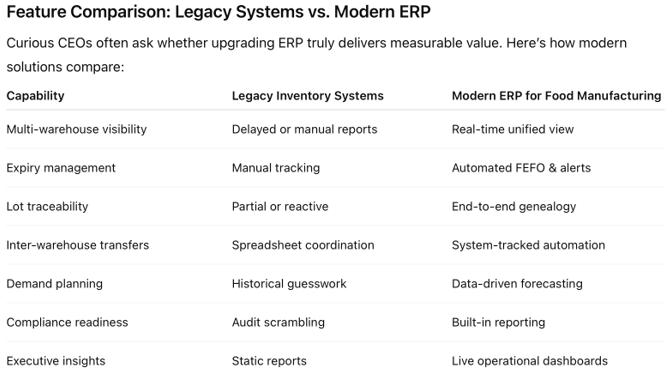
Result: Operations leaders gain predictability, while executives gain confidence in inventory accuracy and financial performance.
Why Implementation Expertise Matters
Technology alone doesn’t solve warehouse challenges. Food manufacturers need ERP configured around real operational workflows—including production scheduling, compliance requirements, and warehouse processes unique to food handling.
That’s where implementation experience becomes critical. A partner who understands both ERP systems and food manufacturing operations can design workflows that align with how your facilities actually run.
Build a Multi-Warehouse Strategy That Works
Warehouse management isn’t just about storage—it’s about timing, traceability, and visibility. Stoneridge Software works with food manufacturers to implement a customized ERP solution that aligns technology with your operational reality, so your ERP becomes a competitive advantage, not just another system. Connect with Stoneridge Software today to design an ERP solution built specifically for your food manufacturing operations.
Frequently Asked Questions
How does ERP improve multi-warehouse inventory accuracy?
ERP centralizes inventory data so every warehouse updates in real time. This eliminates duplicate records, manual reconciliation, and outdated reports, ensuring planners and warehouse teams work from the same accurate information.
Can ERP help reduce food spoilage?
Yes. Automated expiry tracking, FEFO picking rules, and aging inventory alerts help teams move products before expiration, significantly reducing waste and write-offs. ERP systems can also support component lot tracking, ensuring that if a raw material lot expires earlier than the planned finished-good lot, the system can trigger an expiration mismatch warning or automatically adjust the finished product’s expiration date to match the earliest expiring component.
Is ERP useful for companies with both production and distribution warehouses?
Absolutely. ERP connects manufacturing, storage, and distribution workflows, allowing inventory to move seamlessly between facilities while maintaining full traceability and compliance documentation.
How long does a food manufacturing ERP implementation typically take?
Timelines vary based on company size, warehouse complexity, and customization needs, but phased implementations allow organizations to gain visibility improvements early while expanding functionality over time.
Will ERP disrupt current warehouse operations during rollout?
A structured implementation approach minimizes disruption through process mapping, user training, and staged deployment, allowing warehouses to continue operating while transitioning to improved workflows.
Under the terms of this license, you are authorized to share and redistribute the content across various mediums, subject to adherence to the specified conditions: you must provide proper attribution to Stoneridge as the original creator in a manner that does not imply their endorsement of your use, the material is to be utilized solely for non-commercial purposes, and alterations, modifications, or derivative works based on the original material are strictly prohibited.
Responsibility rests with the licensee to ensure that their use of the material does not violate any other rights.