















Scaling Copilot Across Microsoft 365 for Real Business Impact
Most organizations no longer struggle getting started with Microsoft Copilot, the Microsoft 365 AI-powered assistant, but we have found that many struggle to scale it efficiently and effectively for their business. Early curiosity and executive interest often lead to quick wins, but as access expands, consistency can break down. Usage becomes uneven, expectations outpace results, and questions around governance and value begin to surface. What initially feels like momentum can become fragmented across teams and tools.
In the video below and in this blog, we’ll explore why scaling Copilot can sometimes stall and what it actually takes to move from early experimentation to consistent, organization-wide impact across Microsoft 365. We’ll also look at how to turn your early traction into something repeatable, measurable, and aligned with how work actually gets done.
Scaling Copilot Requires More Than Access
It’s common to assume scaling Copilot is primarily a distribution challenge: assigning licenses, running a few demos, providing training, and adoption will follow. However, in practice, that rarely is enough.
Access without context leads to inconsistent usage. One-time enablement doesn’t create lasting behavior change, and demos, while useful for sparking interest, don’t establish the habits needed for sustained adoption. Without a clear connection to daily work, Copilot remains something people experiment with rather than rely on.
What works, looks different. Scaling happens when Copilot is intentionally embedded into workflows, reinforced over time, and supported by governance that enables, not restricts, adoption.
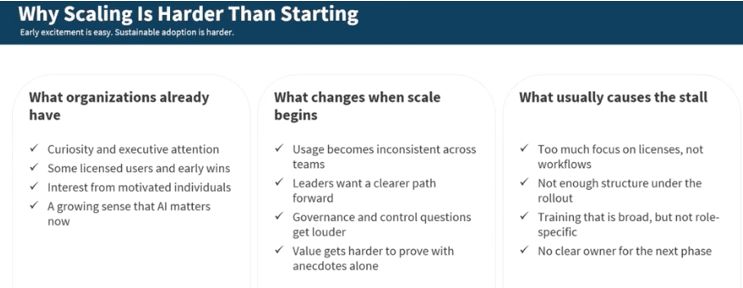
Real scale happens when Copilot becomes part of your everyday work, useful, governed, and embedded in how work gets done. Achieving that level of consistency requires more than adoption efforts; it requires a deliberate operating model that supports scale over time. Let’s take a closer look at what that model looks like in more detail.

An Operating Model for Successfully Scaling Copilot
When your organization moves beyond early experimentation, scaling Copilot stops being an adoption challenge and becomes an operating model question. Success is no longer defined by access or initial usage, but by whether Copilot is consistently embedded into how work gets done across the organization.
That shift requires more than isolated initiatives. It depends on a set of reinforcing capabilities that work together as organizations scale. In practice, we consistently see three connected pillars that determine whether scaling stalls or becomes embedded in day-to-day workflows. These pillars are not separate efforts, they function as a system that balances adoption, visibility, and control. They are:

Champions Program:
A champions program drives adoption through people and shared momentum It brings together a small group of engaged users who help translate Copilot into real work, build practical use cases, and create peer-driven momentum across the organization.
Insights & Analytics:
Insights and analytics provides visibility into usage and business value and helps organizations move beyond basic adoption metrics to understand how Copilot is actually being used. This is where it is delivering value, and where additional enablement is needed.
Governance:
Governance enables scale through control, security, and structure defines access, protects data, and ensures compliance, creating the foundation for scaling Copilot with confidence across the organization.
These three elements reinforce one another. When they are in place together, they help prevent the common pattern of early adoption followed by a scaling plateau.
Below we’ll take a closer look at each pillar, starting with how you turn early momentum into sustained adoption through a champions program.
Champions Program: Turning Momentum into Adoption
Early excitement around Copilot is valuable, but without structure, it fades quickly or becomes uneven across teams. A champions program helps turn that early momentum into sustained adoption.
This approach brings together a small, cross-functional group of users who learn by doing, not just by training. The focus is on real work and real use cases.
Typically, this includes:
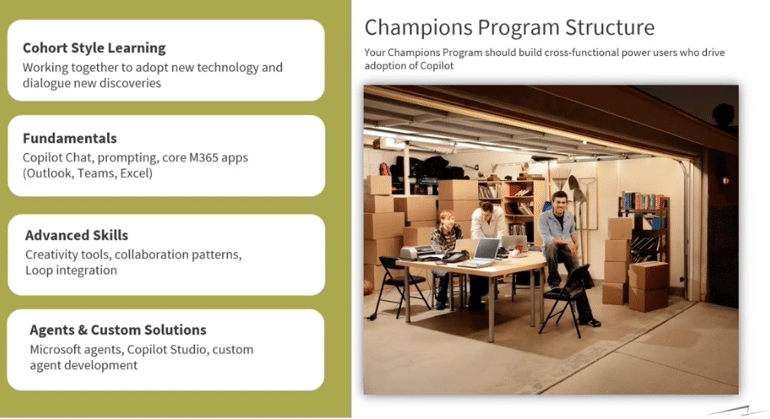
● Cross-functional participation (IT, marketing, operations, HR)
● Live demos paired with hands-on problem solving
● Practical use cases tied directly to day-to-day responsibilities
Over time, champions extend their impact beyond their own teams. They reinforce habits, share what works, and help others adopt new capabilities as they emerge.
This shifts adoption from a centralized effort to a peer-driven model that scales more naturally.
The result:
● Adoption becomes continuous, not event-based
● Learning is embedded in daily work
● Momentum is sustained internally, not externally driven
As adoption expands, visibility becomes essential. However, having a champions program is not enough, you need to also understand how Copilot is actually being used and where it is delivering value through insights and analytics.

Insights & Analytics: Moving from Activity to Impact
As adoption expands, visibility becomes essential. Your organization needs to understand how Copilot is actually being used and where it is delivering value.
From Access to Activity: The Baseline View
The starting point for visibility lives in the Microsoft 365 admin center. Here, reporting provides a foundational view of adoption across Microsoft 365 apps, including Copilot. Within the Copilot reporting blade, organizations can see whether users are enabled, whether they are active, and basic usage across Copilot experiences such as chat and agents.
This view is intentionally simple, but also limited. It is essentially binary: users either have access or they do not, and they are either active or they are not. While this helps answer foundational questions like “Is Copilot turned on?” and “Are people using it?”, it does not explain how it is being used or embedded into real work.
For deeper operational insight, organizations move into the Microsoft Copilot Control System. This layer goes beyond usage and focuses on how Copilot is configured, how it is being consumed, and, importantly, how it is governed.
At this level, teams can understand which Copilot experiences are deployed, how agents are being used, and whether governance controls are in place to support safe, scalable adoption. This becomes critical as usage expands beyond early pilots into broader organizational rollout.
From usage to impact: understanding business value
Once your organization reaches a meaningful scale (often around 50 users or more), the next shift is from usage tracking to value measurement. This is where the Copilot dashboard analytics powered by Microsoft Viva Insights becomes especially important.

Instead of focusing only on whether Copilot is being used, Viva Insights helps answer a more strategic question: Is Copilot changing how work gets done? It enables organizations to analyze trends over time, compare adoption across teams or roles, and identify where Copilot is becoming embedded in daily workflows versus where it is only being used superficially.
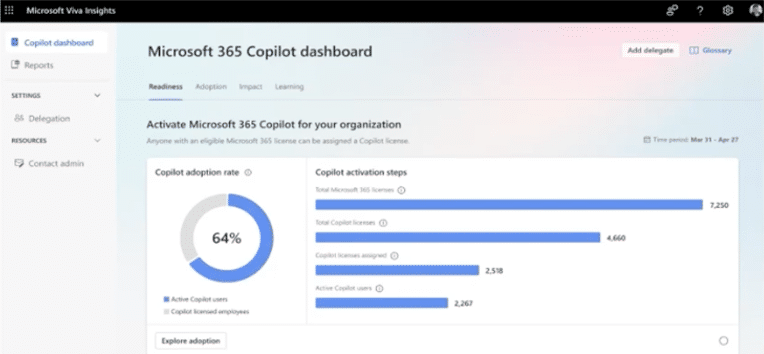
As organizations gain clearer visibility into usage and impact, the value is not just in reporting—it is in action.
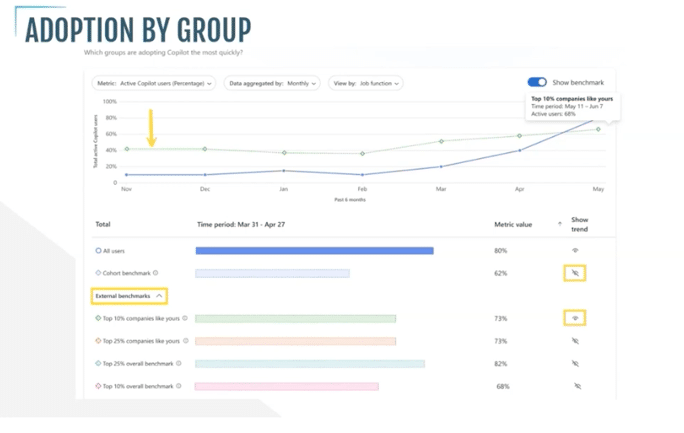
More advanced analytics make it possible to:
- Identify where adoption is lagging
- Target enablement efforts more effectively
- Focus on high-impact use cases
- Continuously refine rollout strategy based on real behavior
This creates a feedback loop: insight drives action, and action strengthens adoption.
Ultimately, scaling Copilot requires progression across three layers of understanding access, configuration, and impact. Each layer answers a different question, and together they provide the foundation for sustainable, enterprise-wide adoption.
As organizations build maturity in how they interpret these signals, the next natural step becomes ensuring that this growth is not only effective but also governed, secure, and ready to scale.
Governance: Enabling Scale with Confidence
As Copilot becomes more widely used within your organization, governance becomes foundational, not as a constraint, but as the structure that makes scale possible. This includes the ability to:
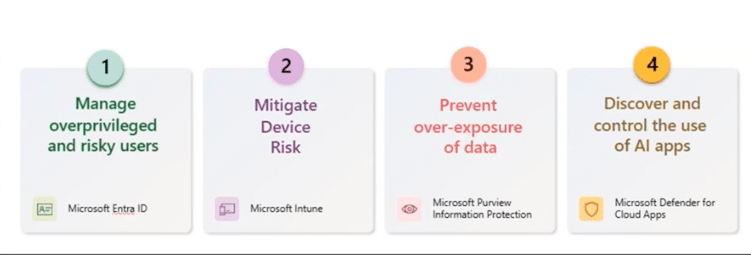
A strong governance model ensures alignment across:
- User access and permissions
- Device and environment compliance
- Data protection and information control
These controls are designed to scale with the organization. Once in place, they apply consistently across users and systems, reducing manual oversight while maintaining security and compliance.
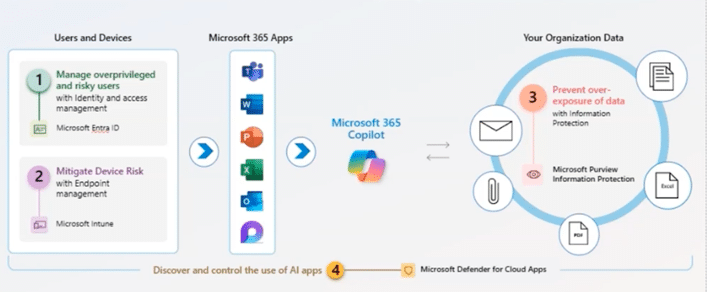
When governance is established early, it removes friction later. Teams can adopt Copilot more freely because guidelines are already in place. This creates a more sustainable model for growth, one where scale does not come at the expense of control.
Scaling Copilot Is a Progression, Not a Switch
It is important to note that scaling Copilot doesn’t happen in a single step. It evolves as your organization builds readiness across multiple dimensions, not just technology, but people, processes, and alignment.
Four key areas define readiness:
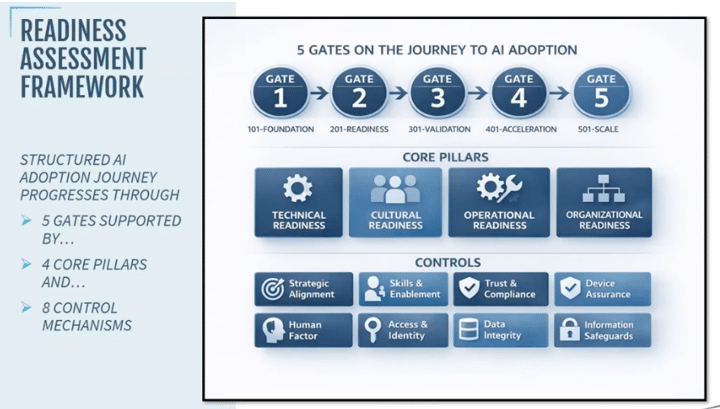
- Technical readiness: The underlying infrastructure, access model, and security posture that determine whether Copilot can be deployed safely and effectively across the environment.
- Cultural readiness: The degree to which teams are open to changing how they work and are willing to adopt Copilot as part of their day-to-day workflows.
- Operational readiness: How well Copilot use cases are connected to actual business processes and embedded into existing workflows, rather than sitting alongside them.
- Organizational readiness: The broader level of digital adoption across core tools like Microsoft Teams, OneDrive, and SharePoint, which influences how naturally Copilot can be integrated into work.
Together, these dimensions provide a clearer view of where an organization is today and what needs to strengthen before scaling further.
From there, progression typically follows three stages:
- Early stage (limited structure): Copilot is exploratory, with limited alignment or governance
- Developing stage (emerging alignment): Use cases begin to form and initial structure is introduced
- Scaling stage (enterprise impact): Copilot is embedded into workflows with measurable business outcomes
Successful organizations move through these stages, not skipping any step. Recognizing this progression helps prioritize the right actions at the right time.
Efficiency vs Engagement: A Signal of How Adoption Is Progressing
Lastly, it is important to highlight a pattern that becomes visible in real-world usage data and helps complete the picture of how Copilot adoption progresses over time. One of the more subtle, but meaningful, signals is how user behavior shifts as people move from exploring Copilot to embedding it into their everyday workflows.
In more advanced stages of adoption, usage patterns often shift in a way that signals deeper integration rather than decline. Specifically:
- Usage frequency may decrease
- Effectiveness increases as users become more familiar with how to apply Copilot
- Users rely more on saved prompts, repeatable workflows, and established patterns
This matters because it indicates Copilot is no longer being actively “used” in an experimental sense, it is becoming part of how work is done.
As this shift occurs, success is less about volume of interactions and more about consistency, efficiency, and how naturally Copilot is embedded into workflows.
Taken together, these changes are a subtle but important signal that Copilot is moving from experimentation into a more established way of working.
So, How Can You Scale Copilot for Business Impact?
Scaling Copilot inside your organization is not a single initiative or a deployment milestone. It is a progression shaped by how well people, processes, and technology align over time.
Organizations that succeed treat Copilot not as a tool to be rolled out, but as a capability to be built, supported by champions who drive adoption, insights that guide decisions, and governance that enables scale with confidence.
When these elements work together, Copilot stops being something teams experiment with and becomes part of how work is actually done. That shift, from access to integration, is what defines sustainable, organization-wide impact.
For More Information on AI and Copilot Adoption
If you’re exploring what it takes to scale Copilot effectively across Microsoft 365, or you’re trying to move beyond early adoption into something more structured, we can help you think through the practical next steps.
At Stoneridge Software, we work with organizations to build the foundations for sustainable AI adoption through Copilot, including champions programs, adoption measurement, and governance models that support scale without adding unnecessary complexity.
Whether you’re just getting started or refining an existing rollout, we’re happy to share what we’re seeing in real implementations and help you assess where your organization is today, and what it will take to move forward with confidence. Contact us today, our team is here to help!
*Author and presenter Tyler Allard also contributed to this article.

Under the terms of this license, you are authorized to share and redistribute the content across various mediums, subject to adherence to the specified conditions: you must provide proper attribution to Stoneridge as the original creator in a manner that does not imply their endorsement of your use, the material is to be utilized solely for non-commercial purposes, and alterations, modifications, or derivative works based on the original material are strictly prohibited.
Responsibility rests with the licensee to ensure that their use of the material does not violate any other rights.