















Technology Adoption in Agriculture: Turning Investments Into Real Change
When you invest in Microsoft Dynamics 365, Levridge, CRM platforms, or Artificial Intelligence (AI) tools such as Copilot, the technology can create new ways to manage information, automate work, and make better decisions.
But implementing the technology is only part of the equation. The bigger question is whether people actually change the way they work and whether the business realizes the value those tools were intended to deliver. In my experience, working on both the client and consulting sides of technology implementations, that is often where the real challenge begins.
For agricultural organizations, that challenge is becoming increasingly important as Enterprise Resource Planning (ERP), CRM, and AI become more connected to day-to-day operations. A successful implementation isn’t simply about getting Dynamics 365 Finance & Supply Chain or Levridge live. It’s about helping people use the system effectively and creating lasting change across the business.
In this blog, we’ll look at what it takes to move beyond go-live and build lasting adoption, including how to define a clear vision, establish meaningful success measures, engage the business, and support people through change. To understand why those efforts matter, it helps to first look at what can get in the way of lasting adoption.
If you’d rather hear me walk through these ideas, you can watch the full session. Or keep reading for a closer look at the strategies and practical steps that can help support adoption before, during, and after implementation.
Why Technology Projects Struggle
A successful technology implementation involves more than getting the technology up and running. It also requires people and the organization as a whole to change how it works.
In many cases, the gap shows up in day-to-day work. You may see this common pattern:
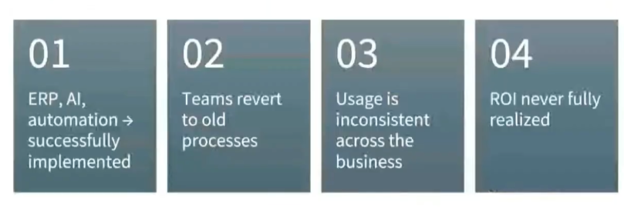
- Employees continue using old processes alongside the new system.
- Spreadsheets or paper processes remain outside the system.
- People enter the same information in multiple places.
- Adoption varies across departments, teams, or locations.
- Employees use the system because they have to, rather than because it makes their work better.
- Teams continue relying on familiar workarounds instead of the processes built into the new system.
When that happens, the technology may be working, but you aren’t getting the full value from it. The investment has been implemented, but it hasn't fully changed the way the business operates. This is critical because if adoption ultimately determines whether a technology investment delivers value, then we need to rethink how we define implementation success.

Installation Success vs. Adoption Success
When we talk about implementation success, it’s easy to focus on the measures that are easiest to track: Was the project delivered on time? Did it stay within budget? Was the planned scope completed?
Those measures matter, but they don't necessarily tell us whether the organization will gain the full value from the technology.
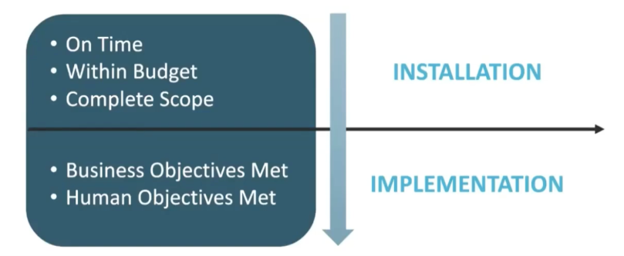
I think about implementation success in two categories:
1. Installation success:
- Delivered on time
- Stayed within budget
- Completed the planned scope
- Successfully deployed the system
2. Adoption success:
- Business objectives are being achieved.
- People are using the system effectively.
- Processes are changing as intended.
- Users are getting value from the technology.
- The organization is realizing the expected business outcomes.
A project can go live on time, stay within budget, and deliver everything in the original scope, yet still fall short if the business and people objectives aren't being met.
Go-live is a milestone, not the finish line. What matters next is whether people adopt the technology, processes change, and the organization realizes the outcomes it expected from the investment.
Start With a Vision for Change
Before getting into the details of a new system, start with a clear idea of what you want the technology to help the business accomplish.
When we begin working with an organization through our roadmap process at Stoneridge, one of the first conversations we have is about vision and success criteria. The vision isn't a replacement for the company's overall business strategy. It should connect directly to where the organization wants to be in the next three to five years.
That makes it important to involve senior leaders early, including the CEO or COO, CFO, CIO, and functional business leaders. They can help connect the technology investment to the direction of the business.
The vision should also go beyond “implement Dynamics 365 and Levridge” or “move to the cloud.” It should describe what the organization wants to do differently.
For an agricultural organization, that might mean:
- Growing more easily: Adding new locations or acquired businesses without creating another layer of complexity.
- Scaling operations: Supporting growth without requiring the same increase in administrative work.
- Helping users work more independently: Giving employees better access to the information and tools they need.
- Improving visibility: Making it easier to see what is happening across locations and business units.
For example, if acquisitions are part of the company's three- to five-year plan, scalability could be part of the technology vision. That might lead to a specific success measure: how easily the organization can add a new location or business when the opportunity comes along.
Starting with that bigger picture helps keep the implementation focused on why the organization is making the investment in the first place, rather than simply what software it is putting in place.
Turn the Vision Into Meaningful Success Criteria
Once you have a clear vision, the next step is to define what success actually looks like. This is where a broad goal becomes something you can measure.
The success criteria should answer a simple question: What are we trying to accomplish by making this change?
For an agricultural organization, that could include:
Business outcomes
- Automate accounts payable.
- Improve collections.
- Automate scale ticket imports.
- Improve communication with suppliers.
- Make day-to-day workflows more efficient.
Technology outcomes
- Reduce the number of applications employees need to use.
- Improve integration between systems.
- Improve how data is handled and shared.
- Reduce reliance on disconnected tools.
Process outcomes
- Replace paper- or Excel-based processes with workflows in the system.
- Standardize processes across plants, elevators, mills, or other locations.
- Automate approvals and notifications.
- Reduce manual work and duplicate data entry.
These are just examples, but they illustrate an important point: “Implement Dynamics 365” isn't a success criterion. The success criteria should describe what the organization expects the technology to help it accomplish.
That also gives you something to come back to after implementation. Instead of simply asking whether the system went live, you can ask whether the changes you set out to make are actually happening.
Four Foundations of Adoption Success
Having a clear vision and success criteria gives an implementation direction. But in practice, adoption depends on how the organization brings people into the change. From what I have seen, four areas make a consistent difference.
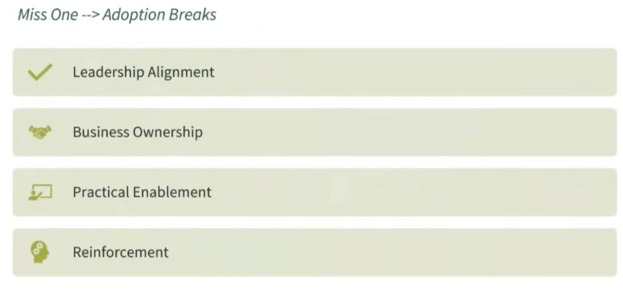
1. Leadership Alignment
Adoption starts with leadership. The people leading the organization need to understand the change, support it, and reinforce the new way of working.
The right leaders will vary depending on the technology and the functions involved. For a CRM implementation, that may mean strong involvement from sales leadership. For an ERP implementation, alignment may need to extend across IT, finance, operations, and other business functions.
In the ERP implementations I've worked on, Operations can be especially important. It's not enough for IT and finance to see the value. Operations leaders also need to understand how the new system can improve the way their teams work.
That means connecting the technology to tangible business benefits, such as reducing manual work, improving efficiency, or using AI to automate inventory replenishment.
2. Business Ownership
Adoption can't sit with IT alone. The people who understand how the business actually operates need to be part of the implementation from the beginning.
That means identifying business process owners and subject matter experts who can help make decisions about how processes should work in the new system.
For an agricultural organization, that could include leaders and subject matter experts from:
- Operations
- Finance
- Sales
- Procurement
- Plant or elevator operations
- Other functional areas affected by the implementation
These people shouldn't simply be asked to approve decisions at the end. They should have an active role throughout the implementation.
3. Practical Enablement
One of the biggest differences I've seen in successful implementations is how early the business gets involved. Rather than designing the system separately and handing it over to users at the end, bring the people who will use it into the process.
That can include:
- Joint process design
- Collaborative configuration
- Conference room pilots
- User acceptance testing
- Training
- Business-led enablement
Business process owners and subject matter experts can help shape the design, work through the system during conference room pilots, lead user acceptance testing, and play a role in training.
The goal is to bring people along throughout the implementation, rather than asking them to adapt to something that was designed without them.
4. Reinforcement After Go-Live
It's when people begin using the system in their day-to-day work that you can really see where additional support is needed.
Continue to:
- Provide training and support.
- Gather feedback from users.
- Look for workarounds or processes happening outside the system.
- Identify barriers to adoption.
- Reinforce the processes the organization agreed to use.
- Make adjustments when something isn't working as intended.
After a long ERP implementation, it's understandable that everyone wants to take a breath when the system goes live. But continued engagement after launch is what helps turn the implementation into lasting change.
Change Management: Before, During and After Implementation
Change management isn't a single training session or something that happens at the end of an implementation. It starts before the project begins and continues after the system goes live.
I think about it in three phases.
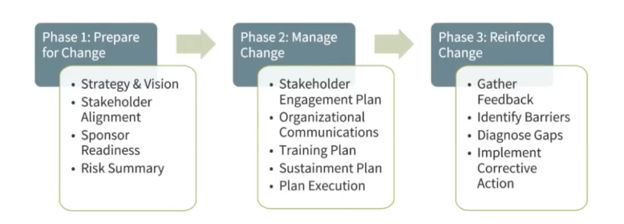
Before: Prepare for Change
Before implementation begins, get clear on who needs to be involved and where you may encounter challenges.
This includes:
- Establishing the strategy, vision, and success criteria.
- Identifying key stakeholders and aligning project sponsors.
- Understanding where resistance or risk may exist.
- Identifying the people or groups that will need additional engagement.
This early work gives you a better idea of where to focus your efforts once the implementation is underway.
During: Manage Change through Engaging and Enabling
As the implementation progresses, the focus shifts to keeping people involved and helping them understand the change.
A few questions are particularly useful: What's changing? Why is it changing? And what's in it for me or my part of the business?
That means:
- Communicating what is changing and why.
- Keeping stakeholders engaged throughout the implementation.
- Involving business process owners and subject matter experts.
- Using power users and subject matter experts to help with training.
- Expanding communication and training beyond the core project team.
The goal is not simply to tell people what the new system will do. It's to help them understand how it will affect their work and give them opportunities to be part of the process.
After: Reinforce and Sustain the Change
Once the system is live, pay attention to what is actually happening. This is where feedback becomes especially valuable.
Continue to:
- Gather feedback from users.
- Identify barriers to adoption.
- Diagnose gaps between the intended and actual processes.
- Take corrective action where needed.
- Continue training and reinforcement.
- Adjust the approach as the organization learns.
Not every implementation will be perfect on day one. In fact, some challenges may not become visible until people are using the system in their everyday work. The important thing is to keep listening, identify what's getting in the way, and make adjustments.
Change is a journey, not a one-time event. Organizations that continue to learn and improve after go-live are better positioned to turn a technology implementation into lasting change.
Measure Adoption Beyond Usage
Once you have defined what success looks like, you need a way to know whether you're getting there. One mistake I see is treating system usage as the measure of adoption. It’s a useful starting point, but it doesn't tell the whole story.
When I think about adoption, I look at it in three levels:
1. Usage: Are people using the system?
This is the easiest level to measure. Are users logging in? Are they completing their work in the system? Are they still relying on spreadsheets, paper, or other tools to get the job done?
Usage data can tell you whether people are in the system, but being in the system doesn't necessarily mean they're using it effectively.
2. Behavior: Are people using it as intended?
The next question is whether the technology is actually changing how people work.
Look for things like:
- Are processes changing?
- Are employees using new capabilities?
- Are teams making decisions differently?
- Are people using AI and data in their day-to-day work?
- Are users taking ownership of the new processes?
For example, an employee in procurement might use a supplier AI agent to change how they communicate with suppliers and manage their work. That's more meaningful than simply knowing the employee logged into the system.
3. Outcomes: Is the business improving?
Ultimately, adoption should connect back to the business outcomes you defined at the beginning.
Depending on the initiative, that might mean:
- Reducing manual work
- Improving efficiency
- Improving margins
- Making better decisions
- Reducing risk
- Achieving other objectives identified in the vision and success criteria
This is where it becomes important to look at the data over time. Compare where you started with where you are after implementation, and continue measuring as adoption grows.
Usage → Behavior → Outcomes
Looking at all three gives you a much better picture of adoption. A system can have high usage without producing the behavior or business results the organization expected.
What Can You Do Now?
You don't have to wait until the system is live to start thinking about adoption. A few practical steps can make a difference:
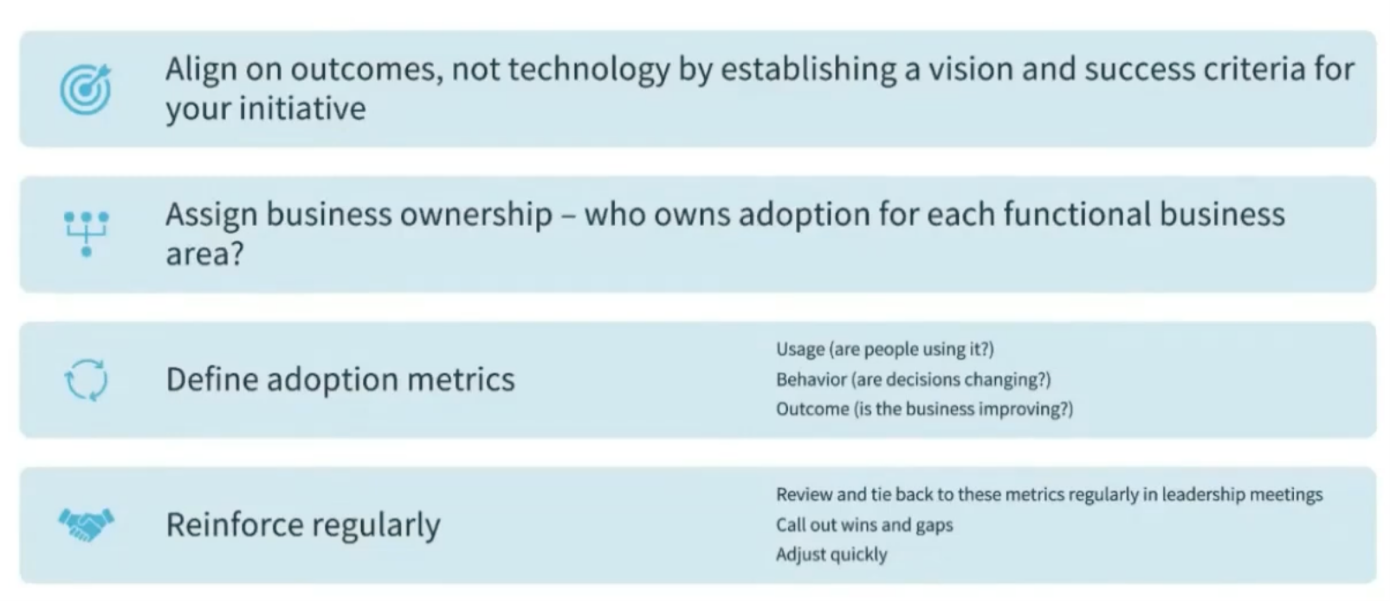
- Align on outcomes, not technology. Establish the vision and success criteria, then revisit them throughout the implementation and after go-live.
- Assign business ownership. Identify who is responsible for adoption within each functional area. IT shouldn't be expected to own adoption for the entire organization.
- Define adoption metrics. Look beyond whether people are using the system. Measure usage, behavior, and ultimately business outcomes.
- Review progress regularly. Bring adoption into leadership conversations, recognize progress, and be willing to discuss gaps. A gap is an opportunity to understand what's getting in the way and improve.
- Adjust as you learn. The implementation plan doesn't have to be the final answer. Keep listening to users, make changes where needed, and continue working toward the outcomes you defined.
Go-Live Is the Beginning
Technology doesn't create lasting change on its own. A successful implementation requires more than putting a new system in place. It requires a clear vision, business ownership, engaged users, ongoing support, and a way to measure whether the organization is actually getting the value it expected.
For agricultural organizations making significant investments in ERP, CRM, and AI, adoption should be part of the strategy from the beginning, not something addressed after go-live.
The goal isn't simply to implement new technology. It's to help people use it effectively, improve how the business operates, and continue building on that progress after the system goes live.
For More Information
Technology adoption doesn't have to be figured out after the implementation is underway. Starting with a clear vision, meaningful success criteria, and a plan for engaging the business can help set the foundation for lasting change.
If you're planning a Dynamics 365, Levridge, CRM, or AI initiative and want to talk through your organization's goals and adoption strategy, reach out to us at Stoneridge Software. Our team can help you evaluate where you are today, identify opportunities, and build a practical path forward.

Under the terms of this license, you are authorized to share and redistribute the content across various mediums, subject to adherence to the specified conditions: you must provide proper attribution to Stoneridge as the original creator in a manner that does not imply their endorsement of your use, the material is to be utilized solely for non-commercial purposes, and alterations, modifications, or derivative works based on the original material are strictly prohibited.
Responsibility rests with the licensee to ensure that their use of the material does not violate any other rights.