














2026 Technology Predictions: What Business Leaders Need to Watch
Every January, technology leaders look ahead and ask the same question: What will help drive my business forward this year? Not five years from now, not abstract hype cycles—but the trends that will realistically impact how businesses operate, invest, and scale over the next twelve months.
Why 2026 Will Be a Defining Year
When searching for specific and measurable information, it’s important to find resources that will give it to you plainly and in a way that helps you understand how it will improve your business’s operations. In this blog, we will focus on what we are seeing firsthand across the Microsoft ecosystem – including Dynamics 365, Power Platform, Microsoft 365, and the rapidly maturing world of Microsoft Copilot and AI-driven automation.
These predictions are grounded in practical experience, rather than speculation. We will focus on three core areas that will shape how organizations run in 2026:
- Business Systems: How ERP, CRM, and operational platforms are evolving to support agent-driven work
- Artificial Intelligence: How AI is moving from experimentation to embedded, multi-agent execution
- Digital Governance: How security, compliance, and data discipline are finally catching up to innovation
Below, we break down these predictions, explore why they matter, and share what business and IT leaders should be thinking about as they plan for the year ahead. Watch the video or keep reading.
1. Business Systems: From Transactions to Agent-Driven Platforms
In the past, people often discussed business operating systems in narrow terms: ERP versus CRM, finance versus operations, front office versus back office. In 2026, that framing no longer holds as business operating systems have become increasingly sophisticated and diverse in their capabilities.
A better way to think about business systems now is that they are any platform that:
- Interacts with users
- Stores and processes digital information
- Supports decision-making, automation, and reporting
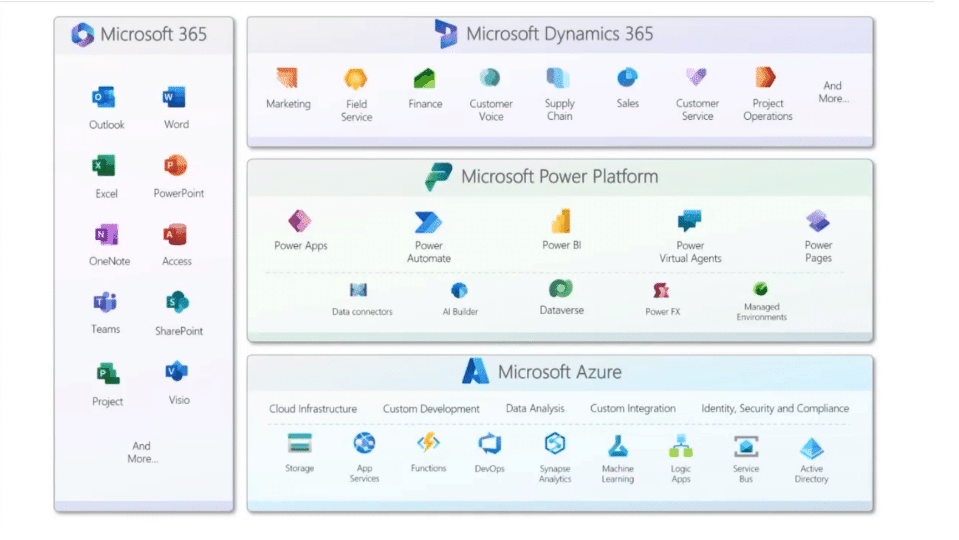
That includes Dynamics 365 ERP and CRM tools, Power Platform solutions, Microsoft 365 applications, and the governance layers that surround them. The biggest shift, though, is how these systems are being redesigned for AI integration.
Business Applications Are Becoming “AI Compatible”
One of the most important predictions for 2026 is a renewed engineering focus on making business applications AI-compatible—not just AI-enabled at the surface level.
Historically, integrating automation or intelligence into ERP and CRM systems required custom integrations, complex APIs, and data extraction and transformation pipelines. Essentially, agents could analyze data, but they couldn’t truly act like users inside the system.
The next generation of business systems is being designed so agents can:
- Navigate menus
- Open forms
- Apply filters
- Create, update, and retrieve records
In other words, agents interact with applications the same way people do—through the user experience—eliminating the need for brittle, point-to-point integrations. Having that ease of use is critical in integrating AI with your business system. AI adoption stalls under the weight of technical complexity.
Model Context Protocol (MCP): A Foundation for Agent Interaction
A major enabler of this shift is Model Context Protocol (MCP). At a high level, MCP defines how an AI agent understands and interacts with a business system. Instead of sending raw data and hoping the model interprets it correctly, MCP provides a structured context to see what actions are available, how screens, forms, and entities relate, and what each field represents.
With MCP in place, the agent can:
- Log into a Dynamics 365 environment
- Navigate to the correct module
- Locate specific records in specific tables
- Perform actions like a trained user, such as viewing a form, finding a menu item, or adding a filter
This matters because MCP is model-agnostic, meaning that if a platform supports MCP, it can work with different AI providers—such as OpenAI, Microsoft Copilot, or other emerging models—giving organizations flexibility without sacrificing control.
Fewer “Classic” Features, More Intelligent Capability
Another important—and often overlooked—prediction is that 2026 will see limited investment in traditional feature expansion for core business processes. That doesn’t necessarily mean innovation is slowing down or that your Microsoft applications will see fewer updates, but it means that priorities have shifted.
With finite engineering resources, tech companies are investing more heavily in AI compatibility, agent frameworks, and automation capabilities.
Rather than adding dozens of new configuration options or niche features, platforms are focusing on enabling agents to handle the work. The implication for customers is clear: the value of a business system is no longer measured by feature checklists, but by how effectively it supports automation at scale.
Agentic AI is Becoming a Core Part of Your Business Processes
Perhaps the boldest prediction under this banner is that it will be difficult to justify purchasing a business system that does not include built-in agent capabilities. Agents are no longer “nice to have”; they are quickly becoming foundational pieces to drive efficiency and boost productivity.
Examples already emerging include agents that:
- Import and validate vendor invoices
- Monitor overdue customer balances
- Reconcile general ledger and subledger discrepancies
- Generate and post routine transactions
These agents operate continuously, reduce manual effort, and surface issues in near real time. They don’t replace staff—but they radically extend what teams can accomplish by automating mundane tasks and allowing them to focus on tasks that matter. For organizations evaluating ERP or CRM platforms, the question is no longer “What does the system do?” but “What can agents do on top of it?”
The Cost of Implementation Will Continue to Decrease
AI won’t just help with daily workflows; it can also help you automate a lot of tasks during the implementation process. While it’s hard to quantify just how impactful it will be, you might be able to use AI tools or agents to help you resolve issues without having to escalate those questions to costly consultants.
Short version: it’s not going to save you 30 percent on implementation costs, but you might be surprised by the savings you can find.
2. Artificial Intelligence: From Experimentation to Execution
Despite all of the talk about how AI is becoming imperative, AI fatigue is a real issue, and after two years of rapid releases and nonstop headlines, many organizations are asking whether the hype has outpaced reality.
While it might be easy to get bogged down by fatigue, the second major prediction is that AI is moving into its most impactful phase yet.
From Websites to AI-Driven Customer Journeys
One of the most significant shifts underway is the way customers discover and purchase products. Instead of starting with Google searches, vendor websites, or e-commerce portals, more users are beginning their journey inside AI tools like Copilot or ChatGPT.
They ask questions, compare options, refine requirements, and increasingly expect the agent to help them complete the transaction. This creates two major implications for businesses in 2026:
- Your website may no longer be the primary customer interface
- AI agents may become the first—and sometimes only—touchpoint
In 2026, organizations must think about how their products, pricing, marketing efforts, and data are exposed to AI systems, not just human visitors.
The Rise of Out-of-the-Box AI Platforms
Another key prediction is the growing importance of AI platforms built into operating systems. In fact, Microsoft’s multi-year investment in embedding Copilot across its entire ecosystem – Dynamics 365, Power Platform, Microsoft 365, Azure, and more – positions it uniquely in this space.
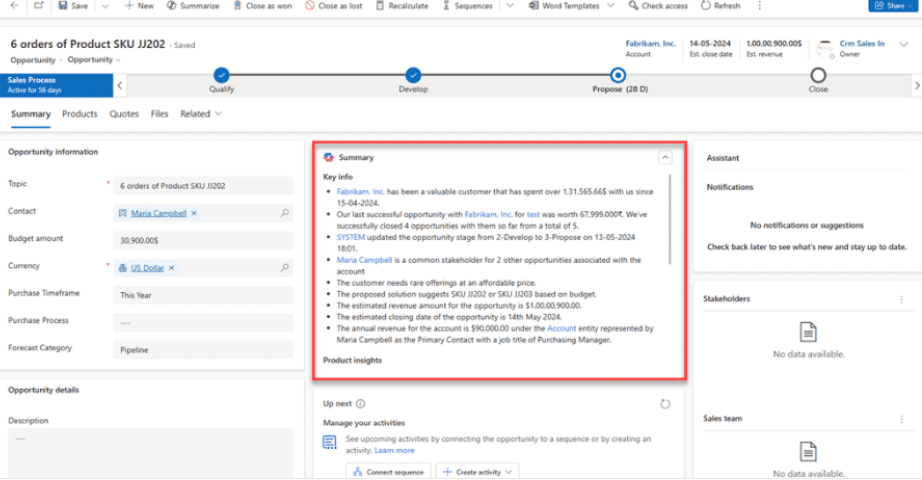
Microsoft’s multi-year investment in embedding Copilot AI across its entire ecosystem—Dynamics, Power Platform, Microsoft 365, Azure—positions it uniquely in this space. You can ask Copilot to help you locate data within your ERP or CRM, have it craft a customer communication for you in Word, summarize emails you missed while out of office, and much more.
Platforms with AI built in can accomplish several key things, including but not limited to:
- Sharing context across applications
- Enforcing governance consistently
- Enabling agents to operate end-to-end
This depth of integration is difficult to replicate with bolt-on AI solutions. In 2026 and beyond, platforms designed for AI from the ground up will increasingly outperform those that treat AI as an add-on.
Multi-Agent Systems Become Practical
The conversation around AI is shifting from single agents to multi-agent systems, where one agent completes a task, hands the results off to another agent, and triggers a downstream process within your workflows.
Some examples include:
- Month-end close workflows
- Automated reconciliation and variance analysis
- Opportunity-to-production planning
Having multiple agents within your system reduces handoffs, eliminates delays, further reduces human intervention, and allows your business to operate continuously 24/7.
Industry-Specific Models Gain Momentum
The last prediction under AI advancements is the emergence of industry-specific AI models. Rather than relying solely on massive general-purpose models, organizations can use certain systems and find AI models exclusively trained for things like:
- Distribution
- Manufacturing
- Professional services
- Financial operations
- And more
The benefit of having targeted agents that deal with specific industries or workflows is lower costs, higher relevance, and faster, more accurate outcomes. Microsoft has made strides in this area with new and upcoming agents specifically for account reconciliation, approvals, sales orders, and more.
For businesses, this means AI investments can become more targeted and measurable in 2026.
3. Digital Governance: Maturity Replaces Fear
The old saying goes, “where there is smoke, there is fire”. When it comes to tech, the saying should be: “Where there is a major technology shift, there will be new and expanding governance.” From cloud computing to mobile platforms, the new age of AI is no exception.
Formalized AI Governance and Ethical Frameworks
In earlier years, security and governance were often deal-breakers. Today, they are design assumptions. Microsoft has a governance structure around things like:
- Identity
- Data access
- Compliance
- AI usage
With the integration of AI, these governance frameworks are far more advanced and sophisticated than they were even two years ago. We now know more about the pitfalls of using AI improperly, and as a result, governance conversations are becoming more constructive and less restrictive.
Data Discipline Becomes a Competitive Advantage
While governance concerns may be quieter, data quality is becoming louder, and AI systems are amplifying existing issues like poorly structured data, inconsistent naming conventions, and unclear data ownership. AI tools work best with clean, well-structured, and accurate data.
In 2026, organizations will increasingly discover that their agents fail not because AI is unreliable—but because the data feeding it isn’t ready. Before you rush to implement AI or use built-in AI features within your operating system, you might want to analyze the cleanliness of your data.
Additional Digital Governance predictions include:
- Platform-driven governance: Newer tools like Microsoft Purview drive implementations and governance and can give you a holistic view of your data across on-premises, multi-cloud, and SaaS environments.
- AI-Powered Cybersecurity: Artificial Intelligence can help you identify and report on areas where people are interacting and isolate issues to help secure your environment.
Final Thoughts: 2026 Is About Execution
The predictions for 2026 are not about radical disruption. They’re about refinement, maturity, and execution.
Business systems are becoming platforms for intelligent agents. AI is moving from novelty to infrastructure. Governance is evolving from an obstacle to an enabler.
For organizations willing to rethink how work gets done, 2026 represents a powerful opportunity—not to chase trends, but to operationalize them.
Stay On Top of Business Technology Advancements with Stoneridge Software!
Our team is constantly keeping up with technology trends and finding ways for you to take advantage of the latest and greatest tools that can help your business thrive.
Get in touch with our experts today to learn more!

Under the terms of this license, you are authorized to share and redistribute the content across various mediums, subject to adherence to the specified conditions: you must provide proper attribution to Stoneridge as the original creator in a manner that does not imply their endorsement of your use, the material is to be utilized solely for non-commercial purposes, and alterations, modifications, or derivative works based on the original material are strictly prohibited.
Responsibility rests with the licensee to ensure that their use of the material does not violate any other rights.