














Building Agents That Actually Work: From MCP to Trustworthy Automation
In Part 1 of getting your organization ready for AI, we focused on the work behind the win—strategy, governance, data readiness, and a phased rollout that drives adoption without creating unnecessary risk. In Part 2, building agents that work, we’ll continue that foundation and shift into execution: what it means to create agents that connect to your business systems, how to think about reliability and accuracy, and the practical design choices that turn “cool demos” into automation your teams can trust and keep using.
Through new technologies and AI updates, creating highly specialized agents that address specific workflows is easier than ever.
Understanding Model Context Protocol
One of the most important is Model Context Protocol (MCP), a standard that helps AI agents interact with applications.
In simple terms, MCP allows agents to understand how to interact with systems like:
- Dynamics 365 ERP and CRM systems like Finance, Supply Chain Management, Business Central, Sales, Field Service, and Customer Service
- The Microsoft Dataverse
- Microsoft 365 tools like SharePoint, Outlook, Teams, Excel, Word, and more
- Any other custom business applications you are running or reside within your system
Without MCP, developers would need to build custom integrations every time an AI system needed to interact with an application. It provides a standard for your agents to access and operate across your system much more easily to unlock faster development and broader automation.
One important thing to note about MCP is that doesn’t make the agent understand your business process and how it operates. That’s where your team – in combination with an AI agent – are vital.
Accuracy vs Summaries
When designing agents, it’s important to distinguish between two types of outputs.
Probabilistic outputs:
These are old school programming and statistical models, where you are just asking the agent to grab data from a field that you already know is accurate. This includes, but is not limited to:
- Summaries
- Analysis
- Recommendations
Deterministic outputs:
These use AI to review multiple pieces of data to provide the best analysis of the data using fixed rules and logic. Includes but is not limited to:
- Financial data
- Contracts
- Transactions
Smart AI architecture combines both in its approach. For example, you can use AI summaries to prepare for a customer meeting or summarize your to-do list for the week. Alternatively, you would use deterministic automation to generate a financial document or a recap of sales for Q1.
At the end of the day, it’s important to have a balance of both within your system.
How to Build a Good Agent
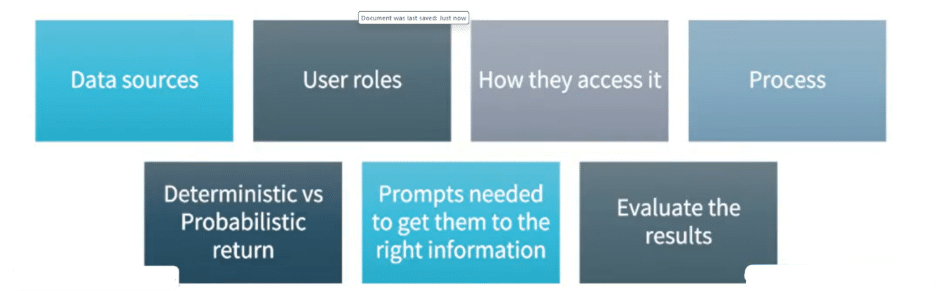
Like a well-trained employee, effective agents are built around roles and processes, not just isolated tasks. To design a strong agent, you will need:
- Defined and cleaned data sources: If you build an agent, don’t overload it with data. Only feed it the data it needs to perform tasks and streamline processes. Make sure your data is ready to go before building your agent.
- Clear user roles and functions: Like with employees, agents should only be able to access the data that is relevant to their roles. For example, you wouldn’t want an agent that gives you customer sentiment summaries to access financial data. Blocking agents from accessing data they don’t need will give you better results. This also helps with compliance and data governance.
- Well-structured prompts and instructions: Vague prompts will return vague results. It’s important to test prompts with your team and find the prompts that are best for your workflow, whether they are pre-built or custom. One of the nice things about Copilot is that you can save prompts. So, when a prompt works, you can simply save it in the prompt library and notify relevant team members that it’s there.
- Clear data processing rules around accuracy vs interpretation: As mentioned above, you need to define whether your agent will be analyzing data for summaries or providing you with completely sound and resolute numbers.
- Results evaluation: Like any other technical tool or software solution, you need to keep an eye on it and track how things are going. If your agent is ineffective, it will slow workflows down and potentially sour your team on AI.
Organizations often start small with simple agents and gradually expand them into more powerful automation tools. Over time, you can develop a library of agents that support various business functions within your system.

Continuous Improvements – Don’t Settle Down
AI is not a “set it and forget it” tool. AI adoption is an ongoing capability, and like conducting performance reviews for your employees, you need to do the same for agents.
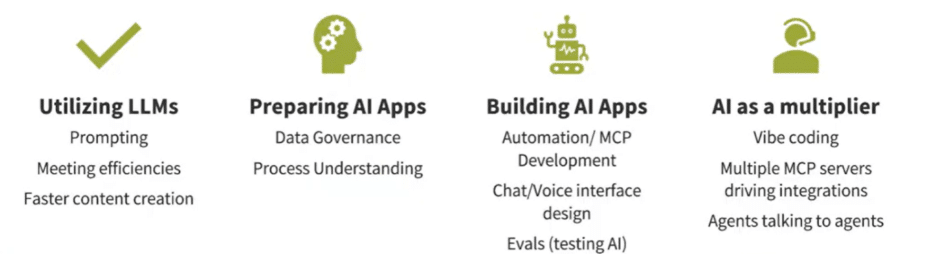
Organizations typically move through several stages of AI maturity:
Stage 1: Using Large Language Models
Getting your team used to AI starts with using Large Language Models for productivity tasks. This can help with:
- Learning to prompt effectively
- Summarizing meetings
- Creating action items
- Drafting emails and documents
- Generating reports and presentations
This stage builds AI fluency across your team in the early stages of AI adoption.
Stage 2: Data Governance and System Design
Even with AI, protecting your data and ensuring that both agents and employees interact with data safely is paramount. Once your team is used to using AI, you can begin preparing your data and systems for deeper AI use by:
- Improving data governance
- Defining processes
- Structuring data sources
- Establishing governance frameworks
This stage – in combination with stage one – lays the foundation for more intelligent and deeper automation.
Stage 3: Building AI Apps
This includes:
- Setting up automation rules and developing MCP
- Designing agents so they can operate within your workflows
- Configuring the chat and voice interface design so it works for your team
- Testing AI to make sure that it’s working properly for your organization
Steps one through three lay a solid foundation for more intelligent data analysis and deeper automation within your system.
Stage 4: Use AI as a True Force Multiplier
This is where AI really takes off. In advanced environments, organizations begin building:
- Building custom agents
- AI-powered applications
- Running multiple MCP servers to drive integrations
- Automated workflows
- Multi-agent systems interacting with each other
At this stage, AI moves beyond productivity tools and becomes a core operational capability.
Ready to Start Your AI Journey?
AI adoption isn’t about chasing the latest technology trend. It’s about thoughtfully preparing your organization to work smarter, move faster, and unlock new opportunities.
At Stoneridge Software, helping organizations become AI-ready is what we do every day. From governance and security assessments to Copilot deployments and custom agent development, we help clients implement AI in a way that is secure, strategic, and scalable.
Talk to the Stoneridge team today!
Here's few of our pre-packaged AI and Copilot services that clients are leveraging:
- AI Agent Tools: Learn more about how Agent Builder, Copilot Studio and Azure AI Foundry can help you build smarter agents.
- AI Executive Briefing: Prep your leadership team with a 90-minute educational session on high level AI concepts and how you can roll AI out effectively in your organization.
- AI Readiness Assessment: A complimentary evaluation of your systems, processes, and organizational mindset going into developing an AI plan.
- Copilot Flight Plan: Align leadership on business value, assess your environment, and prepare your teams to use AI effectively.
- Copilot Flight Schools: Hands-on training that helps your team understand where they can and should apply Copilot within their daily tasks.
- Liftoff Labs: Workshops where the Stoneridge experts walk you through the steps in creating Copilot agents to help with your unique business needs.

Under the terms of this license, you are authorized to share and redistribute the content across various mediums, subject to adherence to the specified conditions: you must provide proper attribution to Stoneridge as the original creator in a manner that does not imply their endorsement of your use, the material is to be utilized solely for non-commercial purposes, and alterations, modifications, or derivative works based on the original material are strictly prohibited.
Responsibility rests with the licensee to ensure that their use of the material does not violate any other rights.