















ERP with Automated Production Scheduling for Food Manufacturers
For food and beverage manufacturers, production scheduling is the engine that keeps operations moving. Every batch, every line changeover, and every delivery commitment depends on having the right materials, equipment, and labor available at exactly the right time.
When production planning is managed in spreadsheets or disconnected systems, even minor disruptions can lead to late shipments, excess inventory, overtime, and customer penalties. That is why many food manufacturers are modernizing with Microsoft Dynamics 365 Business Central or Dynamics 365 Supply Chain Management.
The benefits are straightforward: better schedules, fewer disruptions, and more orders delivered on time and in full.
Why Production Scheduling Is So Complex in Food Manufacturing
Unlike many other industries, food and beverage manufacturers must balance production efficiency with strict quality and regulatory requirements.
Common scheduling constraints include:
- Shelf-life and expiration dates
- Lot-controlled ingredients
- Formula and recipe dependencies
- Allergen segregation
- Sanitation and clean-in-place (CIP) downtime
- Same base items, different item types
- Seasonal demand spikes
- Packaging availability
- Labor shortages
- Customer-specific delivery windows
These variables make manual scheduling increasingly difficult as production volumes grow.
When planners rely on spreadsheets, they often spend hours each day updating inventory data, adjusting production priorities, resolving material shortages, sequencing changeovers, or communicating schedule changes to supervisors.
The result is reactive planning that leaves little room for strategic decision-making.
Why Use Automated Production Scheduling?
Intelligent production scheduling applies predictive algorithms to ERP data, autonomously generating optimized production plans that adapt to changing demand constraints.
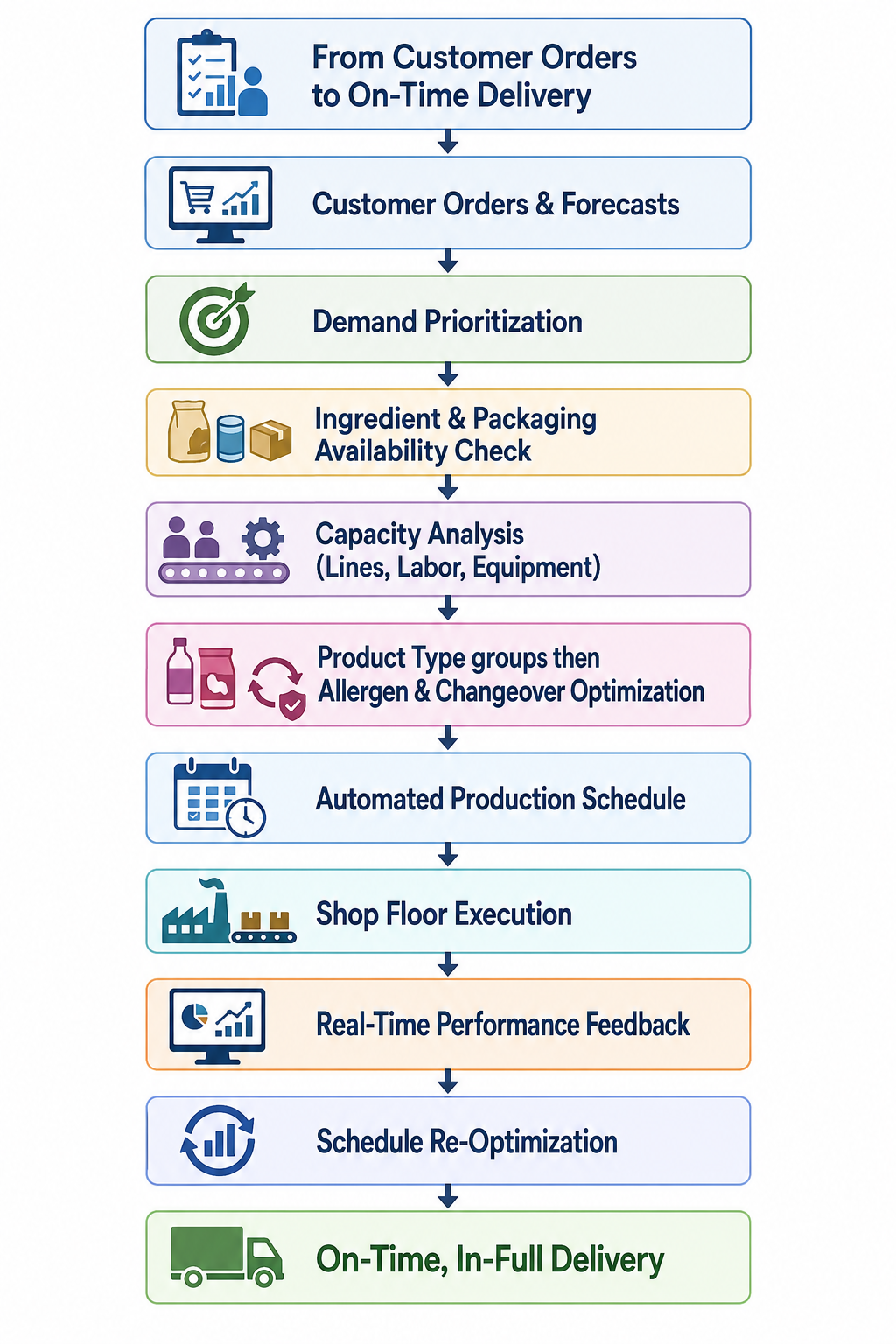
Rather than manually sequencing work orders, the ERP system analyzes:
- Customer orders and forecasts
- Available ingredients and packaging
- Equipment and labor capacity
- Setup and sanitation requirements
- Batch sizes
- Shelf-life constraints
- Due dates and service priorities
Intelligent production scheduling enables operations teams to create optimized schedules based on real-time inventory, allergen sequencing, customer due dates, and other specialized factors. For instance, in production scheduling for bakery & confectionery, the system recommends the most efficient production sequence to maximize throughput and meet delivery deadlines. In Dynamics 365, this capability is supported by Master Planning, finite capacity scheduling, and real-time production visibility.
In Dynamics 365, this capability is supported by Master Planning, finite capacity scheduling, and real-time production visibility.
Illustrated Workflow:
How Automation Improves Deadline Performance
For Directors of Operations, the most important scheduling metric is on-time, in-full (OTIF) delivery. Automated scheduling improves OTIF by ensuring that production plans are based on real-world constraints rather than assumptions.
Benefits include:
- More accurate promise dates
- Reduced scheduling conflicts
- Faster response to disruptions
- Improved line utilization
- Lower expedited freight costs
- Fewer retailer chargebacks
When production schedules are synchronized with inventory and capacity data, operations teams can commit to delivery dates with greater confidence.
D365 Manufacturing ERP Results By the Numbers
A Forrester Consulting Total Economic Impact study commissioned in 2026 found significant benefits for manufacturing businesses using Dynamics 365 ERP. Among organizations with annual revenue in excess of $1 billion, respondents reported significant improvement in areas where legacy systems had been holding them back.
- 62% of survey participants agreed that D365 ERP reduced inventory waste or spoilage and improved demand forecast accuracy.
- An average 25% time savings was reported on demand planning and forecasting.
- 68% of enterprise respondents said implementing D365 ERP reduced legacy maintenance costs.
- 82% of respondents whose businesses automated warehouse operations with D365 ERP (including picking, packing, barcode scanning, and shipping) saw a 25% or greater increase in productivity.
Cost-Benefit Analysis for a Mid-Sized Food Manufacturer

In our experience, food and beverage manufacturers using automation within D365 Manufacturing ERP have seen meaningful cost and efficiency improvements.
Key Operational Benefits of Automated Scheduling
Better Capacity Utilization
Finite scheduling accounts for line speeds, labor availability, and maintenance windows, helping plants maximize throughput.
Reduced Changeover Time
Products can be sequenced by allergen profile, package type, or flavor to minimize cleaning and setup downtime.
Less Waste and Spoilage
Schedules prioritize ingredient usage based on expiration dates, reducing obsolete inventory.
Faster Re-Planning
When a supplier shipment is delayed or an urgent order arrives, planners can regenerate schedules in minutes.
Improved Communication
Production supervisors, procurement teams, and customer service all work from the same real-time plan.
Why Dynamics 365 Is Ideal for Food Manufacturers
Dynamics 365 offers industry capabilities that support the specific needs of food and beverage manufacturers, including:
- Formula and recipe management
- Batch production
- Quality control
- Lot traceability
- Shelf-life management
- Recall readiness
- Multi-site planning
- Warehouse management
- Demand forecasting
Because all functions are integrated on a single cloud platform, planners no longer need to reconcile multiple systems before creating schedules.
Operational KPIs to Track After Implementation
To measure the impact of automated scheduling, Directors of Operations should monitor:
- On-time, in-full delivery (OTIF)
- Schedule adherence
- Capacity utilization
- Changeover time
- Overtime hours
- Product waste
- Expedited freight costs
- Inventory turns
These metrics help quantify both operational improvements and financial returns.
Questions to Evaluate Your Current Scheduling Process
Ask your operations team:
- How many hours are spent manually updating schedules each week?
- How often do schedules change after release?
- What is our current OTIF rate?
- How much overtime results from planning disruptions?
- How much product is wasted due to poor sequencing?
- How quickly are we able to respond to urgent orders?
- Are all teams working from the same production plan?
The answers often reveal substantial opportunities for improving legacy systems.
Ask Us How to Bring Your ERP Up to Speed
By leading ERP modernization, you can improve plant performance while creating a scalable planning process that supports growth. Partnering with Stoneridge Software for Microsoft Dynamics 365 implementation ensures the ERP is configured around your recipes, production constraints, and service goals. Contact us today to see how we can turn scheduling into a competitive advantage.

Under the terms of this license, you are authorized to share and redistribute the content across various mediums, subject to adherence to the specified conditions: you must provide proper attribution to Stoneridge as the original creator in a manner that does not imply their endorsement of your use, the material is to be utilized solely for non-commercial purposes, and alterations, modifications, or derivative works based on the original material are strictly prohibited.
Responsibility rests with the licensee to ensure that their use of the material does not violate any other rights.