















How to Build an AI Strategy with Microsoft Copilot: Lessons from the Moon Landing
What do the moon landing and adopting artificial intelligence (AI) have in common? More than you might think.
When I kicked off our annual Stoneridge Connect conference earlier this year, I shared the story of how the moon landing was a huge gamble, a huge investment and a huge technological challenge – and yet they pulled it off.
Check out the full keynote presentation here to get the full story:
How AI and the Moon Landing are Intertwined
In 1961, the United States committed to putting a person on the moon before the end of the decade. There was just one problem: the technology, infrastructure, and detailed roadmap needed to accomplish it didn’t exist yet. What the country did have was a clear destination, a willingness to invest, and a commitment to figuring out the steps required to get there.
Today, business leaders face a similar moment with artificial intelligence. AI is developing quickly, and its potential reaches far beyond simply giving your employees another productivity tool. Used strategically, AI can reshape how your people work, automate processes, connect information, and give your teams more capacity to focus on high-value work.

But you don’t get there with one giant leap. You get there through a series of smaller, deliberate steps. The lessons of the Apollo program can help you think differently about your AI strategy—and Microsoft Copilot can give you a practical place to begin.
The Race to the Moon
On May 25, 1961, President John F. Kennedy laid out an extraordinarily ambitious goal: land a person on the moon and return them safely to Earth before the decade was over.
At that point, there was no complete plan for accomplishing it. There wasn't a rocket capable of completing the mission or a detailed roadmap showing exactly how the United States would get from where it was to where it wanted to go. What Kennedy established was a destination and a deadline.
The starting position wasn't particularly encouraging, either. The Soviet Union had achieved several important milestones in the space race, while the American space program was still relatively young. NASA itself had only been established in 1958.
The challenge, then, wasn't simply technological. It was organizational. How do you align people, investment, technology, processes, and partners around something that has never been done before?
That's where the similarities between the moon landing and AI strategy begin.
Landing on the Moon: The Story and Success of Apollo
The moon landing represented the culmination of years of incremental progress. The Mercury program explored whether humans could operate in space. Gemini tackled capabilities such as docking and spacewalking. Apollo took those lessons and built upon them to pursue the ultimate objective of reaching the moon and returning safely.
Even Apollo itself wasn't one perfect march forward. Apollo 1 ended tragically with a launch-pad fire that killed three astronauts. Subsequent missions went back to testing fundamental capabilities before crews were sent farther into space. Apollo 8 orbited the moon. Apollo 9 and 10 continued testing and refining the systems required for the eventual landing. Then came Apollo 11.
Success came from learning, adjusting and building upon each previous step.
Your AI strategy should work the same way.
How the Apollo Program Succeeded: People, Investment and Structure
Apollo was a technology story, but it was just as much a story about people.
More than 400,000 engineers, scientists and technicians contributed to the effort, while more than 20,000 companies and universities participated. At its peak, NASA represented roughly 4 percent of the U.S. federal budget, demonstrating the scale of commitment behind the program.
Most importantly, those resources were organized around a clear objective.
There is an important AI lesson here for business leaders. You can purchase powerful technology, but technology by itself doesn't create transformation.
Successful AI adoption requires you to align:
- Technology: The platforms, applications and AI capabilities that make new ways of working possible.
- Data: Clean, accessible and appropriately governed information that AI can use effectively.
- People: Employees who understand how to use AI and where it fits into their work.
- Processes: Workflows that can be redesigned rather than simply layering AI onto inefficient existing processes.
- Leadership: A clear vision of what you're trying to accomplish and why.
You don't need 400,000 people or a NASA-sized budget. You do need alignment.
Outcomes and Innovations Driven by the Moon Landing
Getting astronauts onto the lunar surface was the objective, but much of Apollo's long-term value came from what had to be invented, refined and scaled along the way.
That provides another useful way to think about your AI strategy.
Your ultimate objective might be automating a specific process, building an intelligent agent or significantly improving productivity. But the work required to reach that destination can create additional benefits throughout your organization.
You might improve your data quality. You might finally connect disconnected systems. You might discover unnecessary steps in a process. You might improve governance. You might give employees new skills.
Sometimes the destination creates value. Sometimes the journey toward it creates just as much.

The Moonshot Moment: Parallels Between the Moon Landing and AI Innovation
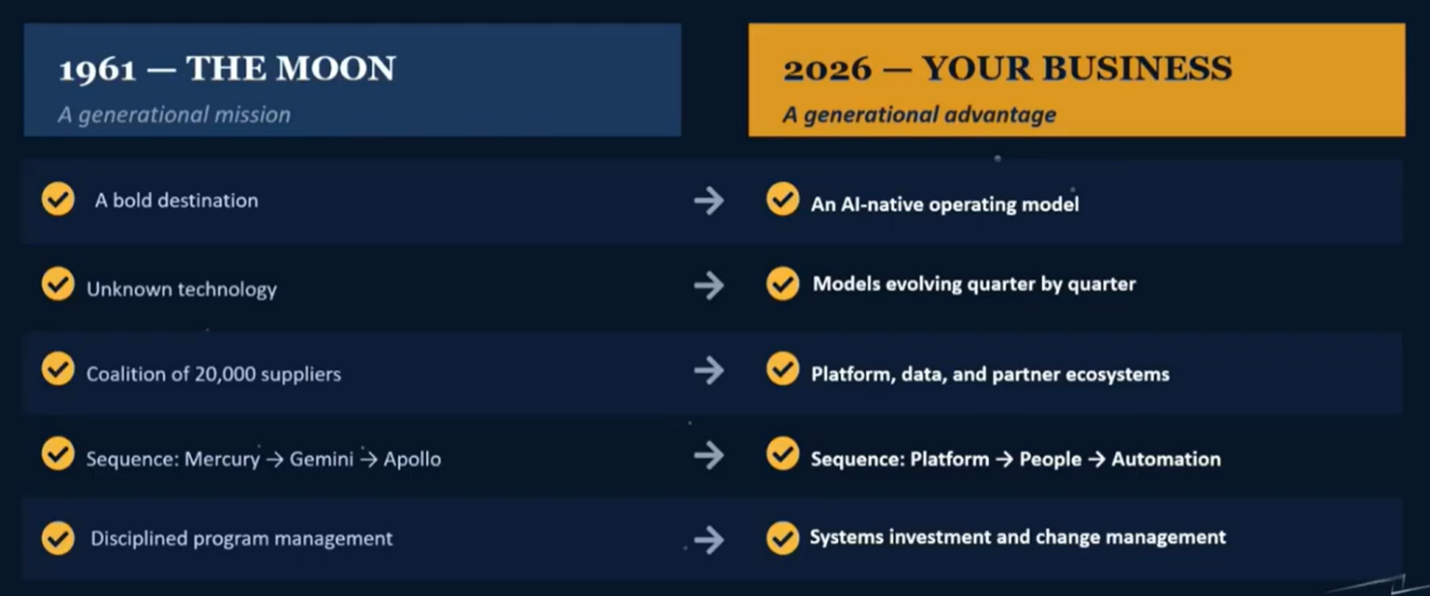
Generative AI has moved from an emerging curiosity to an increasingly practical business capability in a remarkably short period. The next evolution is AI agents, which extend that potential by combining generative AI with automation and the ability to reason across information and workflows.
That's why the comparison with 1961 is useful.
Your organization doesn't need to know precisely what AI will look like five or ten years from now. What you need is a destination.
Think about what an AI-enabled version of your organization could look like. Where are your employees spending hours manually searching for information? Where are people copying information between systems? Which repetitive processes are consuming skilled employees' time? Where could better access to information accelerate decisions?
Those questions help turn "we should do something with AI" into a strategic direction.
The goal isn't simply to use more AI. It's to create an operating model where AI becomes another capability your employees can draw on to get work done more effectively.
Just as Mercury, Gemini and Apollo built upon one another, your organization can progressively move from individual productivity to process automation and increasingly sophisticated AI agents.
Where to Invest for AI Success: Platform, Automation and People
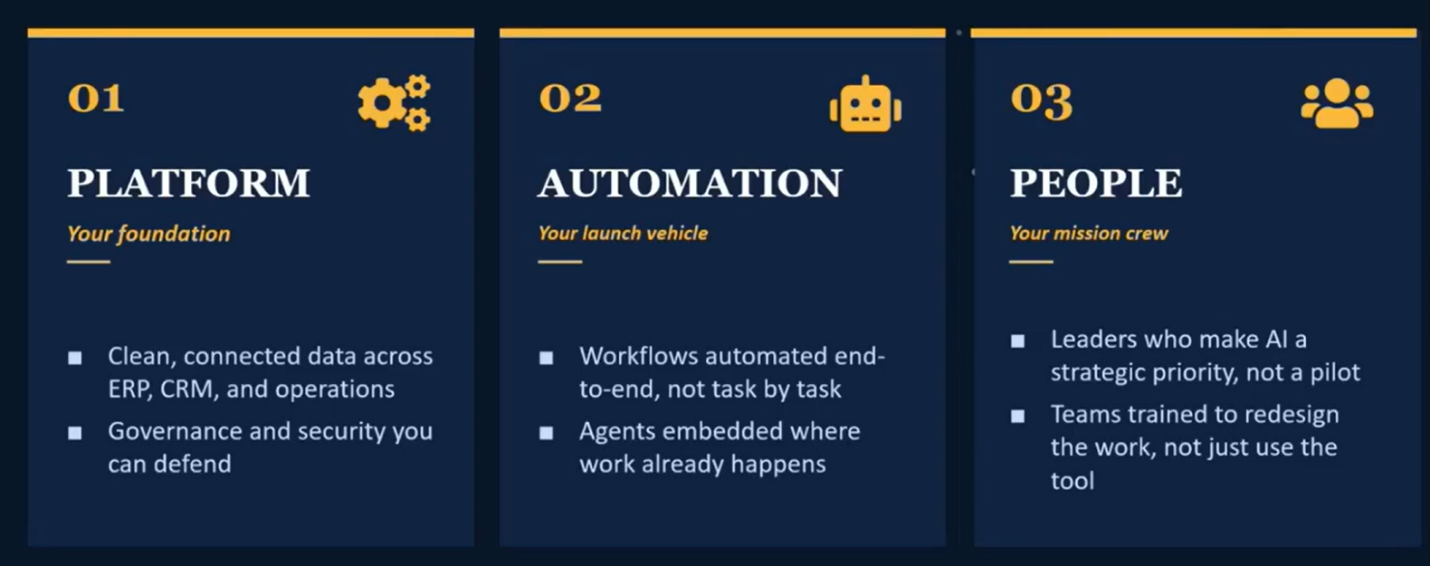
A successful AI strategy needs a foundation. For most organizations, that means concentrating investment across three interconnected areas.
1. Build the Right Platform
AI can work with enormous amounts of structured and unstructured information, but that doesn't eliminate the need for good data.
Your ERP, CRM and line-of-business applications still matter. Clean, connected data gives AI better information to work with and gives you a stronger foundation for automation.
Cloud-based technology can be particularly important here because it gives you a modern platform on which you can continue building. Governance and security need to accompany that modernization so your organization has appropriate rules governing what information exists, who can access it and how it can be used.
AI isn't a substitute for a strong technology foundation. It makes that foundation more important.
Build Automation Around the Way You Actually Work
Automation is where you should resist the temptation to simply take an inefficient process and add AI to it.
Instead, ask a bigger question:
"If we were designing this process today with AI available to us, would we design it the same way?"
Often, the answer will be no.
You know your business better than anyone. Look at your workflows and identify where employees are performing repetitive tasks, searching for information, manually moving data or waiting on routine decisions.
From there, you can determine where automation and AI agents can meaningfully improve the process.
3. Prepare Your People
Your employees are your Apollo crew. They ultimately determine whether your AI strategy becomes a transformative business initiative or another piece of software that never reaches its potential.
That means your training needs to extend beyond showing people which button to click or how to open Copilot.
Teach employees how to prompt effectively. Help them understand what AI does well—and where human judgment remains essential. Give them opportunities to experiment. Most importantly, encourage them to rethink how work gets done.
The objective isn't just to teach people to use the tool. It's to teach them to redesign work with the tool.
Steps for AI Success: Small Wins, Roadmapping and Measuring Success
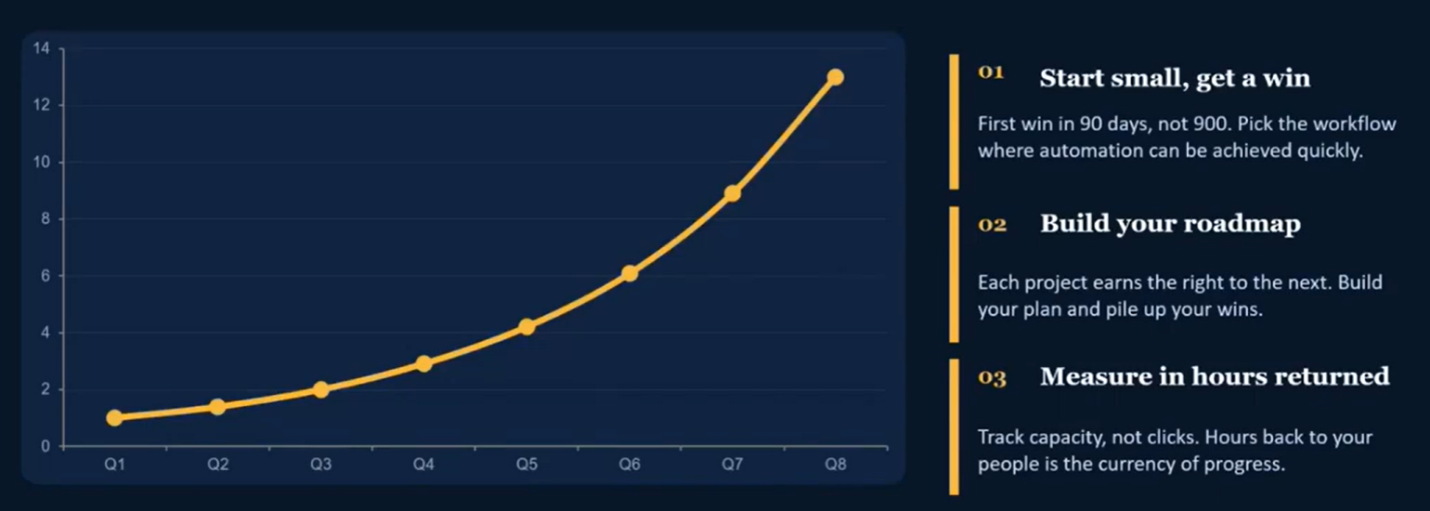
You don't need to begin your AI strategy with the most ambitious project imaginable.
Apollo 11 wasn't NASA's first attempt at spaceflight. Each mission created knowledge and capabilities that made the next step possible. You can apply the same philosophy with AI.
Start Small and Find a Win
Microsoft 365 Copilot can be an effective entry point because it allows your employees to begin incorporating generative AI into tools and workflows they already use.
Let employees learn how to prompt. Let them discover where Copilot saves time. Encourage them to identify repeatable use cases.
The objective of your first initiative isn't to completely transform your company. It's to prove value.
Build Your Roadmap
Once you have that initial success, identify the next capability. Perhaps that's your first AI agent. Maybe it's an accounts payable automation scenario or another repetitive workflow with clean data, a well-understood process, and a measurable opportunity to save time.
Learn what works and what doesn’t. Then you can apply those lessons to the next project.
Your roadmap becomes a sequence of progressively more valuable capabilities rather than one enormous AI transformation project. You can layer in new capabilities over time, with each successful implementation helping to determine and support the next.
Measure Hours Returned
You also need a practical way to measure whether your investment is working. One useful metric is hours returned to your employees.
If Copilot helps someone complete a recurring task in 15 minutes instead of an hour, that reclaimed time has value. Multiply those savings across employees, departments and recurring processes, and productivity gains can become substantial.
The goal isn't necessarily to have employees do more tasks. It's to create more capacity for the work that benefits from their expertise, creativity and judgment. When you measure the hours AI gives back, you can determine how to put those hours to better use.
What the Moon Landing Teaches Us About AI Implementation
Perhaps the biggest lesson from Apollo is that transformative initiatives require sustained commitment. The moon landing wasn't one leap. It was the visible result of thousands of smaller ones.
There were failures. There were redesigns. There were experiments that proved one capability so another could be attempted. There were enormous technical challenges that had to be broken into smaller, manageable problems. An AI implementation requires the same mindset.
Your first prompt won't always give you the answer you want. Your first automation might expose a data-quality problem. Your first agent may need to be redesigned. Some use cases that sound exciting in a strategy meeting may prove less useful in practice. That is not evidence of failure; it’s information you can use to improve the next iteration.
The organizations that make meaningful progress will be those that approach AI seriously, sequence their investments and sustain the effort over time. That means investing in systems, building automation and continuously developing the people who will use these capabilities.
Where to Start with AI: Meet Copilot, Strategic Planning, Security Prep and Enablement
So, where should your organization take its first step?
For many companies, Microsoft Copilot is a logical jumping-off point.
Meet Copilot and Build Familiarity
Start by giving a pilot group practical exposure to Copilot. Encourage your employees to use it in their everyday work and become comfortable with prompting. Rather than prescribing every possible use case, give people enough guidance to safely experiment and discover where AI can help them.
These early experiences also give you something incredibly valuable: feedback. From there, you can learn where employees are finding value, where they are struggling and which potential use cases deserve additional investment.
Develop Your AI Strategy
As familiarity grows, start defining what AI success means for your organization by asking questions such as:
- What are our biggest operational bottlenecks?
- Where are employees spending time on repetitive work?
- What information do our teams struggle to find?
- Which processes could benefit from intelligent automation?
- Where could AI improve customer or employee experiences?
- Which opportunities could produce measurable productivity gains?
Prioritize those opportunities and begin building a roadmap around achievable projects.
Stoneridge can also help you evaluate your current AI readiness and brainstorm practical use cases. The approach outlined in the presentation includes leadership-focused AI strategy conversations and readiness assessments designed to help organizations understand their current position and identify sensible next steps.
Prepare Your Data, Governance and Security
Before you scale AI, make sure your foundation can support it. Review how your data is structured, where it lives and who has access to it. Identify outdated or disconnected systems that could limit what you can accomplish.
You should also evaluate governance and security early rather than treating them as obstacles to address after deployment.
A secure, governed AI environment gives your teams the confidence to experiment while helping your organization maintain control over business information.
Enable Your Teams with the M365 Copilot Flight Plan!
Finally, give your employees time and support to learn.
Stoneridge's Microsoft 365 Copilot Flight Plan, for example, is a structured and effective training program that helps a pilot team get started with Copilot, provides training along the way and uses those early experiences to help determine what should come next. Our comprehensive training can help you assess your team’s AI readiness, pinpoint areas and workflows where you can optimize Copilot’s deployment, and how to create and use AI-powered Copilot agents.
That structure reflects the larger lesson from Apollo.
You don't need to reach the moon on day one. You need to assemble your crew, build the foundation, establish the destination and take the first meaningful step.
Take One Small Step Toward Your AI Strategy with Stoneridge Software
AI represents an opportunity to rethink how your business operates, how your employees spend their time and how quickly you can turn information into action. But capturing that opportunity takes more than simply turning on a new technology. You need a strategy, a secure and connected technology foundation, trained employees, measurable goals and a roadmap that transforms early wins into larger successes.
If you're ready to implement and optimize a smart AI strategy within your business, Microsoft Copilot is the tool to use, and Stoneridge Software is the partner to work with.

Under the terms of this license, you are authorized to share and redistribute the content across various mediums, subject to adherence to the specified conditions: you must provide proper attribution to Stoneridge as the original creator in a manner that does not imply their endorsement of your use, the material is to be utilized solely for non-commercial purposes, and alterations, modifications, or derivative works based on the original material are strictly prohibited.
Responsibility rests with the licensee to ensure that their use of the material does not violate any other rights.