















Stronger Data = Stronger AI: Preparing Your Data for Copilot
Leveraging Copilot within Dynamics 365 Customer Engagement (D365 CE) can feel like a fast track to better insights, and in many cases, it is. However, the insights generated are only as strong as the data it can access, interpret, and connect. If that data is inconsistent, loosely structured, or unclear, the output will reflect that. Getting value from Copilot isn’t about collecting more data, it’s about making the data you already have more usable, more consistent, and better aligned with how your business actually runs.
In this blog, we’ll cover how to get your data ready for Copilot and AI-driven insights, including how to define reporting goals and key performance indicators (KPIs) upfront, why structured data and business process flows outperform free text fields, practical approaches to cleaning and standardizing CRM data, and how strong data practices improve accuracy, build user trust, and support long-term adoption.
You can also watch my session on the topic here:
To begin, strong outcomes from Copilot are built on a clear understanding of what you’re trying to achieve, and that starts by defining the goals and measures that will guide how your data is captured and used.
Start with Clear Goals and KPIs
Before focusing on data structure or AI enablement, it’s important to define your business goals and KPIs that matter most to your organization. Without that foundation, even well-designed systems can produce insights that feel disconnected from real operational needs.
A useful way to think about this is to treat your data like a prompt. A clear, well-structured prompt produces a clearer response, and the same principle applies to your data. When goals are defined up front, they naturally shape how data is captured, structured, and interpreted over time.
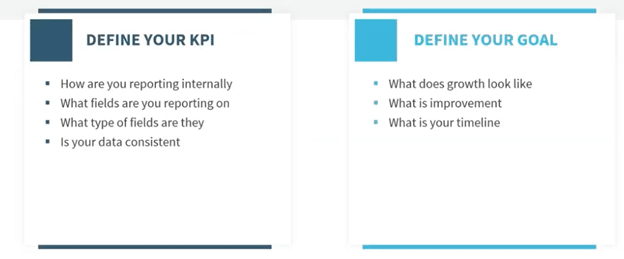
From there, identify the KPIs that reflect how your business actually runs, such as:
- Case resolution criteria
- Average time to close
- Transaction or handling time
These metrics should do more than describe activity, they should reflect performance in a way that is consistent, measurable, and repeatable across teams.
The more consistently these definitions are applied at the point of data entry, the more reliable your reporting becomes over time. And just as importantly, it ensures that future Copilot-driven insights are grounded in the same definitions your teams already rely on today.
Once the goals and KPIs are clear, the next step is working with the reality of the data itself, and often that’s where the real effort begins.
Data Cleanup and Structuring
In most organizations, data isn’t starting from a clean or consistent place. Over time, systems accumulate variations in how information is entered, interpreted, and maintained. Before any AI-insights insights can be relied on, that history has to be acknowledged, addressed and cleaned up.
This work often takes longer than expected. Reviewing historical data, identifying inconsistencies, and understanding how information has been captured over time is rarely a quick exercise. It requires patience, and in many cases, multiple passes through the same datasets as questions and gaps surface.
Cleanup and structuring data typically involve a combination of approaches:
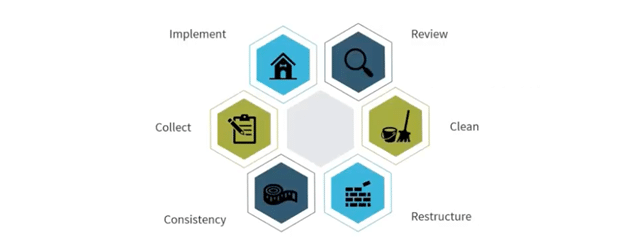
- Bulk updates and controlled processes help standardize large volumes of existing data
- Deprecating rather than deleting records preserves context while reducing noise in reporting
- Reviewing historical data patterns to understand where inconsistencies originated
Once cleanup is underway, structure becomes the next priority. This is where the long-term value is built:
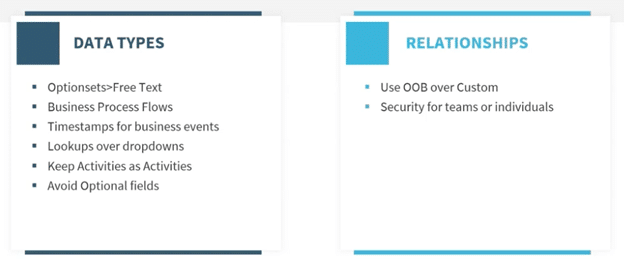
The goal isn’t perfection in a single pass, it’s creating a structure that supports consistent interpretation over time. When data is both cleaned and intentionally structured, it becomes significantly more reliable for reporting, automation, and ultimately Copilot-driven insights.
Once the data is cleaned and structured, the next challenge is ensuring it is captured the same way every time it enters the system.

Ensuring Data Consistency Across Users
Even with strong structure in place, the value of the data ultimately depends on how consistently it is entered and maintained across users. Without that consistency, even well-designed systems will produce uneven results and limit the effectiveness of downstream insights.
A key part of this is user enablement, making sure teams understand not just what to enter, but why it matters. When users understand how their input connects to reporting and decision-making, your data quality naturally improves. Reinforcing this connection is often more effective than relying on system design alone.
From a practical standpoint, consistency is reinforced through a few core patterns:
- Requiring key fields tied to reporting and KPIs ensures critical data is always captured
- Standardizing business processes so your users follow the same steps for similar scenarios
- Guiding input through structured data types, such as option sets instead of free text, to reduce variation at the source
Over time, these practices create a more dependable dataset where information is not only complete, but comparable across records and users. That consistency is what allows Copilot and reporting tools to identify patterns, measure performance accurately, and generate insights that can be trusted at scale.
As data becomes more consistent and structured, the next step is recognizing what strong data actually looks like in practice, and where small design choices make a significant difference.
What Strong Data Actually Looks Like
Strong data starts with a simple principle: your prompt is only as good as your data. If the underlying information is inconsistent, the output, whether from reporting or AI, will reflect that limitation.
One of the clearest distinctions is in how data is captured:
- Option sets vs. free text: Structured values reduce variability and eliminate issues like misspellings or inconsistent phrasing
- Business process flows: Ensure required steps are completed and provide timestamps that show how work actually progresses
At the same time, there are common design pitfalls that weaken data over time:
- Misuse of activity fields, where users store notes or context that should live in structured fields
- Too many optional fields, which often leads to little or no usable data being captured
Addressing these issues is less about adding complexity and more about simplifying the system. Fields that matter should be made mandatory, ensuring critical data is consistently captured. Fields that aren’t being used should be removed or deprecated so they don’t create noise or confusion in the long term. Strong data is about intentional design that makes the right data easy to enter, easy to maintain, and reliable to interpret.
As structure improves, the next step is ensuring the data carries the right connections so meaning is preserved across records.
Using Relationships and Lookups Effectively
Strong data isn’t just about what is captured, it’s about how that information is connected. Relationships and lookups provide the context that turns isolated entries into meaningful, reportable data.
When data is entered as unstructured text, that context is lost. A note like “talked to Jerry today” may seem useful on the surface, but for Copilot, or even reporting, it carries no real understanding of who Jerry is, what account he belongs to, or how that interaction fits into the broader business picture.
By contrast, using relationships changes the way that same information is interpreted:
- A case is connected to a contact (ie: Jerry)
- That contact is linked to an account
- That account carries broader context such as role, relationship history, and company details
This structure allows data to move from isolated notes to a connected system where meaning is preserved. Instead of a dead-end text entry, each record contributes to a larger, reportable dataset that reflects how the business actually operates.
In practice, relationships and lookups are what allow Copilot to move beyond surface-level data and understand context, hierarchy, and connection across the system.
Security and Adoption: Where Trust Is Built or Lost
Copilot operates within the boundaries of existing security roles, meaning your users only see the data they are permitted to access. This is important for governance, but it also introduces a practical consideration: if access is too limited, the insights Copilot can provide may feel incomplete or too narrow to be useful in a broader business context. Aligning security with reporting and decision-making needs is critical to ensuring the system delivers value without unintentionally restricting visibility.
Beyond security, adoption ultimately comes down to trust. When data is inconsistent or unreliable, the outputs reflect that, and your users quickly lose confidence in the system. On the other hand, clean, structured, and consistent data leads to better insights, which builds confidence and supports long-term adoption.
At its core, success with Copilot is not just a technical outcome. It depends on the quality of the data being used and the habits of the people entering it. When both are aligned, organizations see stronger insights, more consistent usage, and greater long-term value from Copilot.
Next Steps to Stronger Data
At the center of everything is a simple reality: clean, consistent, and structured data will always outperform large volumes of poorly maintained information. Copilot doesn’t compensate for data quality, it reflects it. When the foundation is strong, the insights become usable, reliable, and aligned with how your business actually operates.
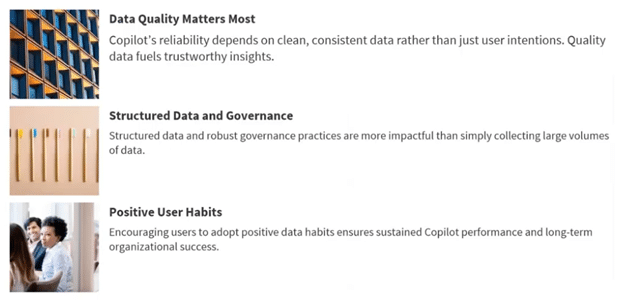
The next step is not a one-time exercise, but an ongoing discipline. It requires regularly reviewing your data quality, reinforcing consistent practices across teams, and continuing to refine how information is captured and structured as the business evolves.
For organizations preparing for Copilot, the most important step is a practical one: assess where your data stands today. Understanding that baseline makes it possible to identify gaps, prioritize improvements, and begin building the structure needed for meaningful Copilot insights.
Whether it’s defining the right KPIs, improving data structure, or building a more consistent approach to CRM data management, Stoneridge Software can help you assess your current data readiness or take the next steps in preparing your data for AI enablement.

Under the terms of this license, you are authorized to share and redistribute the content across various mediums, subject to adherence to the specified conditions: you must provide proper attribution to Stoneridge as the original creator in a manner that does not imply their endorsement of your use, the material is to be utilized solely for non-commercial purposes, and alterations, modifications, or derivative works based on the original material are strictly prohibited.
Responsibility rests with the licensee to ensure that their use of the material does not violate any other rights.