















Do We Really Need AI in Ag? Exploring Microsoft Copilot & AI Agents
Agribusinesses have no shortage of information to manage. From supplier orders and grower relationships to commodity markets, contracts, financial transactions, and daily operations, you are constantly gathering, evaluating, and moving information to keep the business moving.
This work is necessary, but not all of it requires the time and attention it currently receives. That is where Artificial Intelligence (AI) can provide some of its most practical value. The opportunity is to spend less time on repetitive, information-heavy work and more time using that information to make decisions faster, solve problems, and move the business forward.
Microsoft Copilot and AI agents are making this increasingly possible. AI is moving beyond simply helping you draft an email or summarize a document. It can now work across business systems and information to research a question, follow up on a purchase order, identify exceptions in financial data, or assemble a daily position report.
The key is knowing where AI can actually make a difference and having the right data, systems, and processes in place to support it.
In this blog and video, we’ll look at how AI is evolving from an assistive tool into a more capable business resource, where it can provide practical value in agribusiness today, and how you can begin identifying the right opportunities to put it to work.
But, before looking at where AI can create value in agribusiness, it helps to clarify what AI can actually do and where its limits still matter.
What AI Is and Isn’t
For agribusinesses, AI is best understood as a set of capabilities that can help you work with information, identify patterns, and move work forward. Much of this can happen through natural language, allowing you to ask questions and interact with business information more directly. In practical terms, that means AI can help with things like:
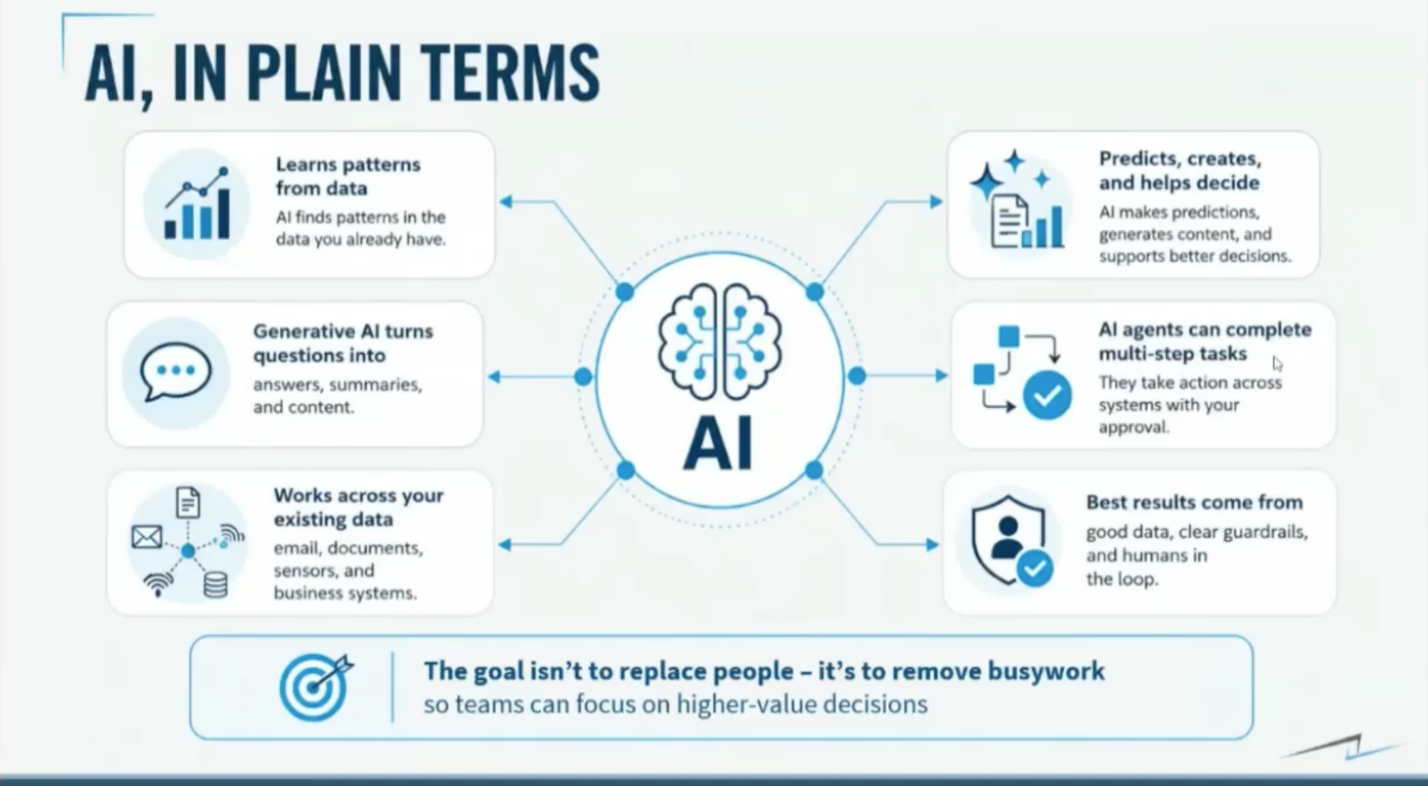
- A way to find, summarize, and work with information
- A tool for identifying patterns and trends across data
- A way to generate content, questions, and responses
- A resource for analyzing information and helping predict outcomes
- An increasingly capable way to automate or carry out parts of a business process
At the same time, understanding what AI can do requires understanding where it still has limitations.
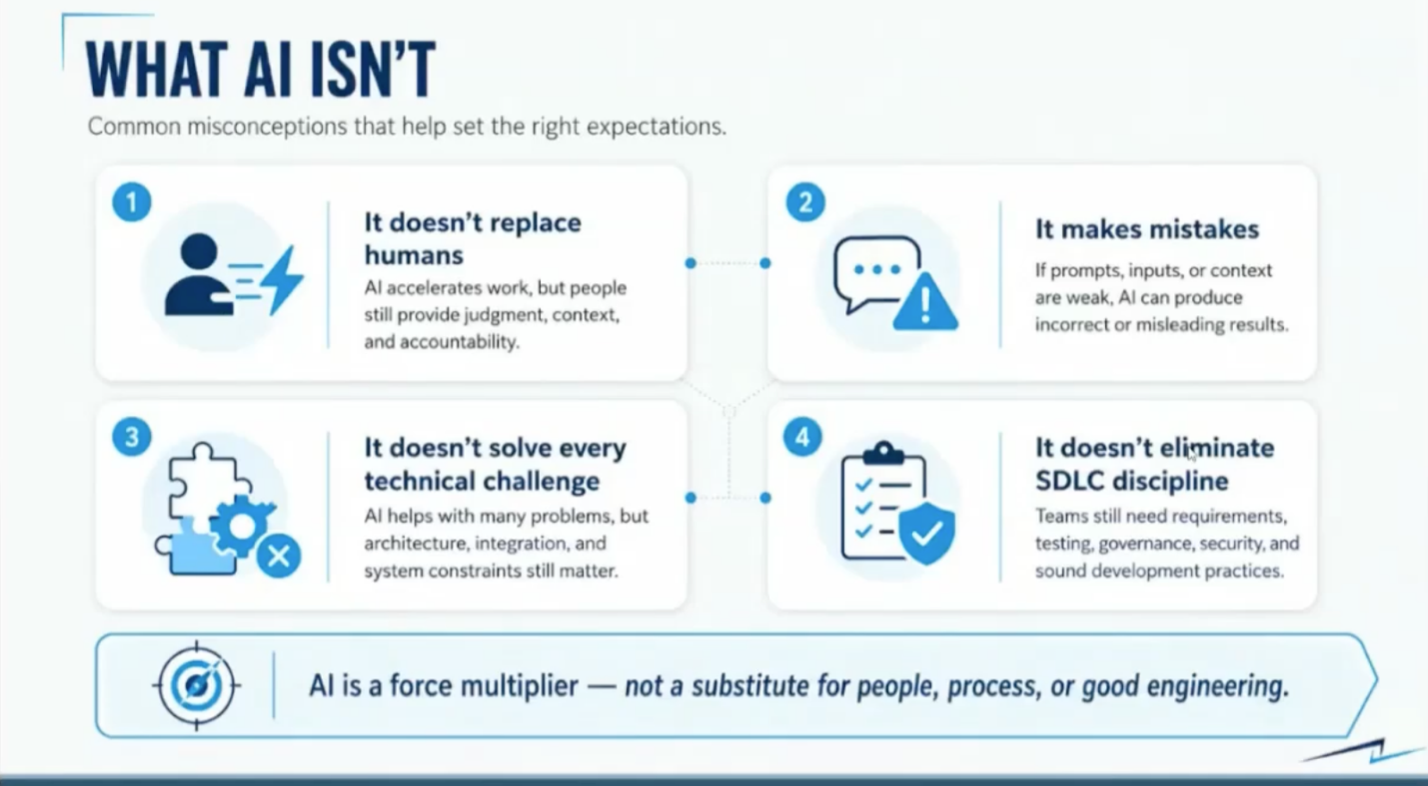
- A solution to every business or technical challenge
- A substitute for sound business processes and expertise
- A reason to assume every output is ready to use without review
- A reason to skip testing, security, documentation, or oversight
Microsoft Copilot provides the ability to interact with these capabilities. As AI has evolved, that interaction has expanded beyond answering questions to include more intelligent workflows and agents that can determine the steps needed to accomplish a task.
What I have found is that the practical value of AI comes from applying it to the right work, with appropriate human oversight. But those capabilities also depend on what sits behind them. For agribusinesses, that starts with connected data and secure business systems.

The Foundation: Connected Data and Secure Business Systems
The benefit AI can provide depends on the information it can access and the context available to it. For an agribusiness, that may include grower information, contracts, purchasing, inventory, sales, and financial transactions spread across business applications and documents. Connecting that information gives AI the context it needs to produce useful results.

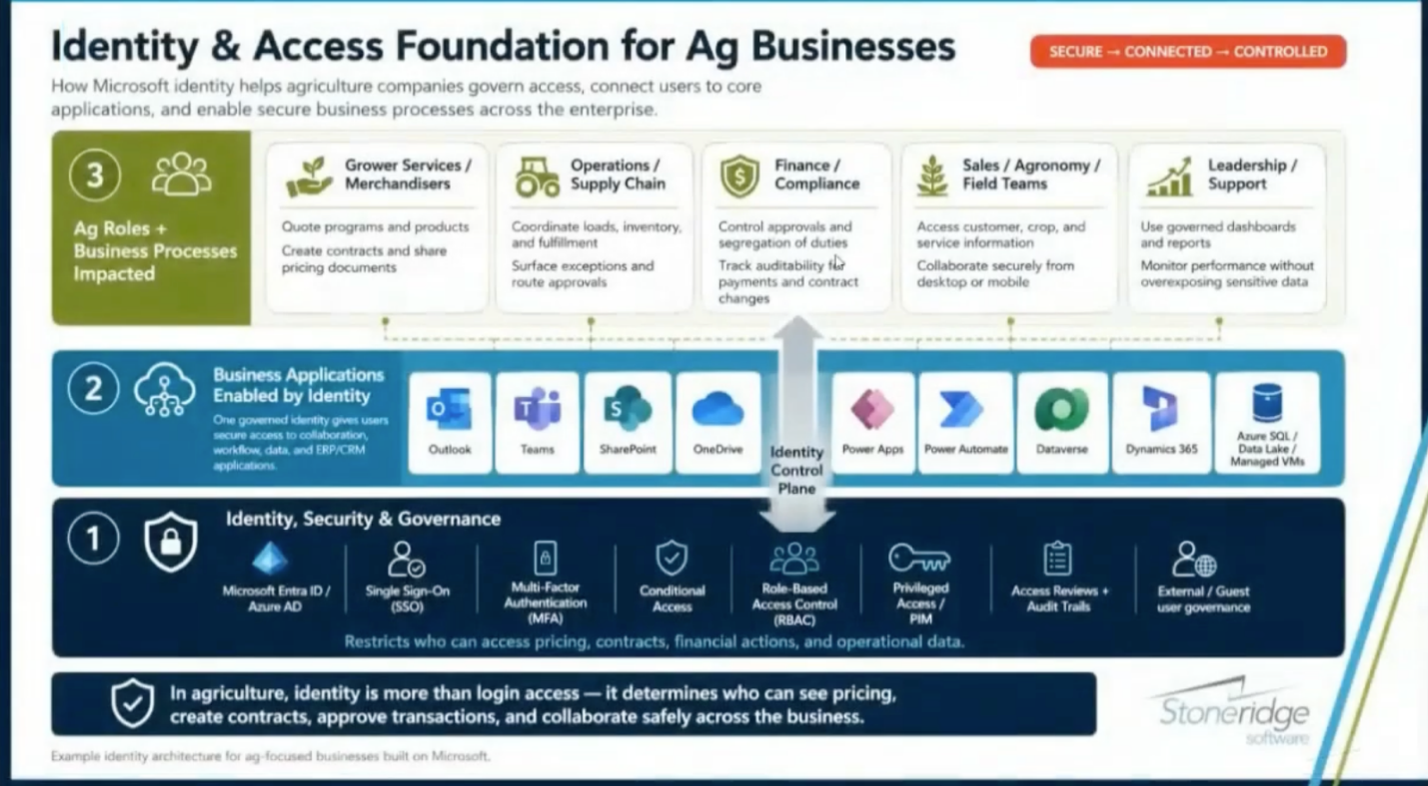
Microsoft’s platform brings together tools such as Microsoft 365, Dynamics 365 (D365), Azure, and Power Platform, allowing AI capabilities to work across business and transactional data. For agribusinesses, that data may also live in industry-specific applications such as Leverage, Stoneridge Software’s agribusiness management solution. Connecting these systems gives AI the business context it needs to provide useful information and support processes across the organization. This also opens the door to agents that can work across systems. For example, an agent could take pricing information from D365 Sales and enter it into Finance and Operations rather than relying on a manual transfer.
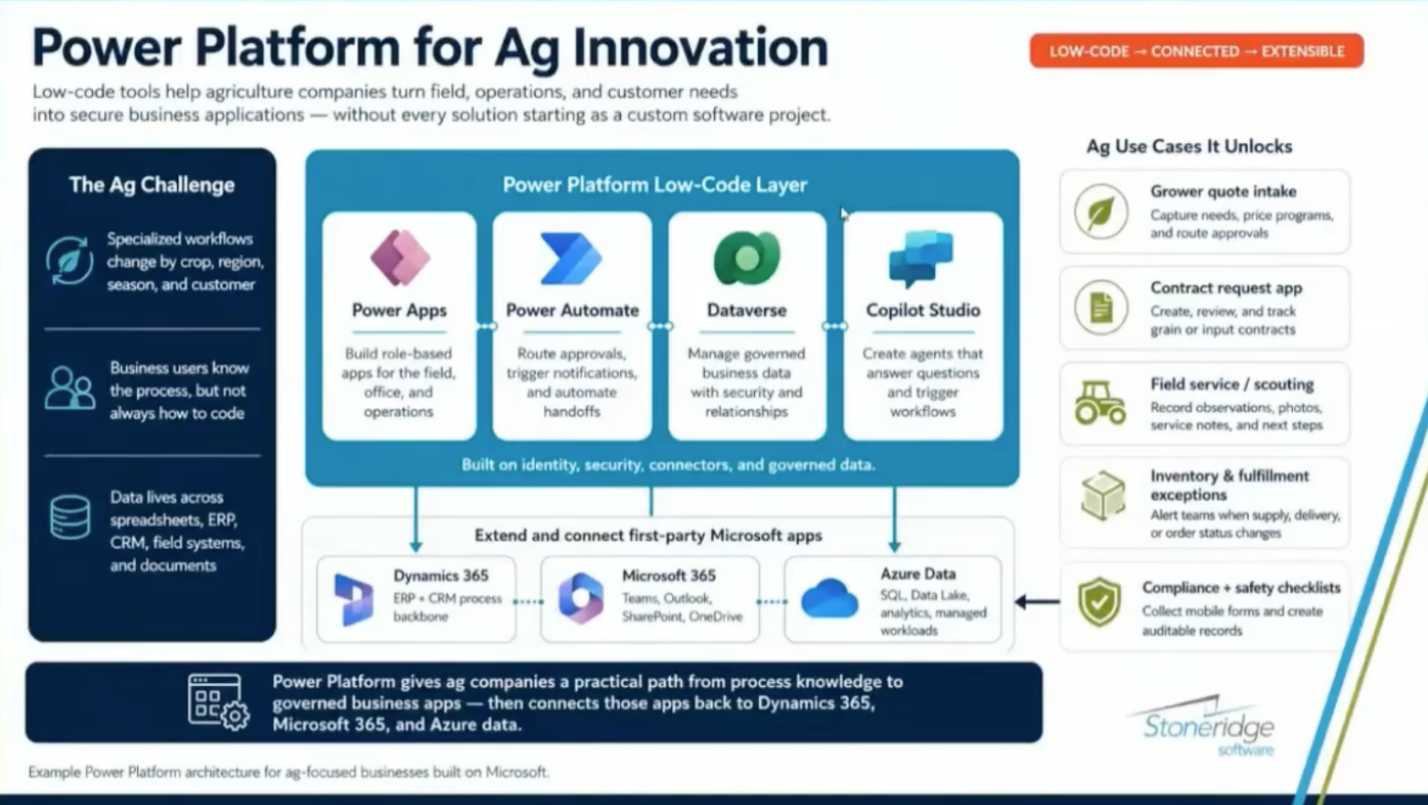
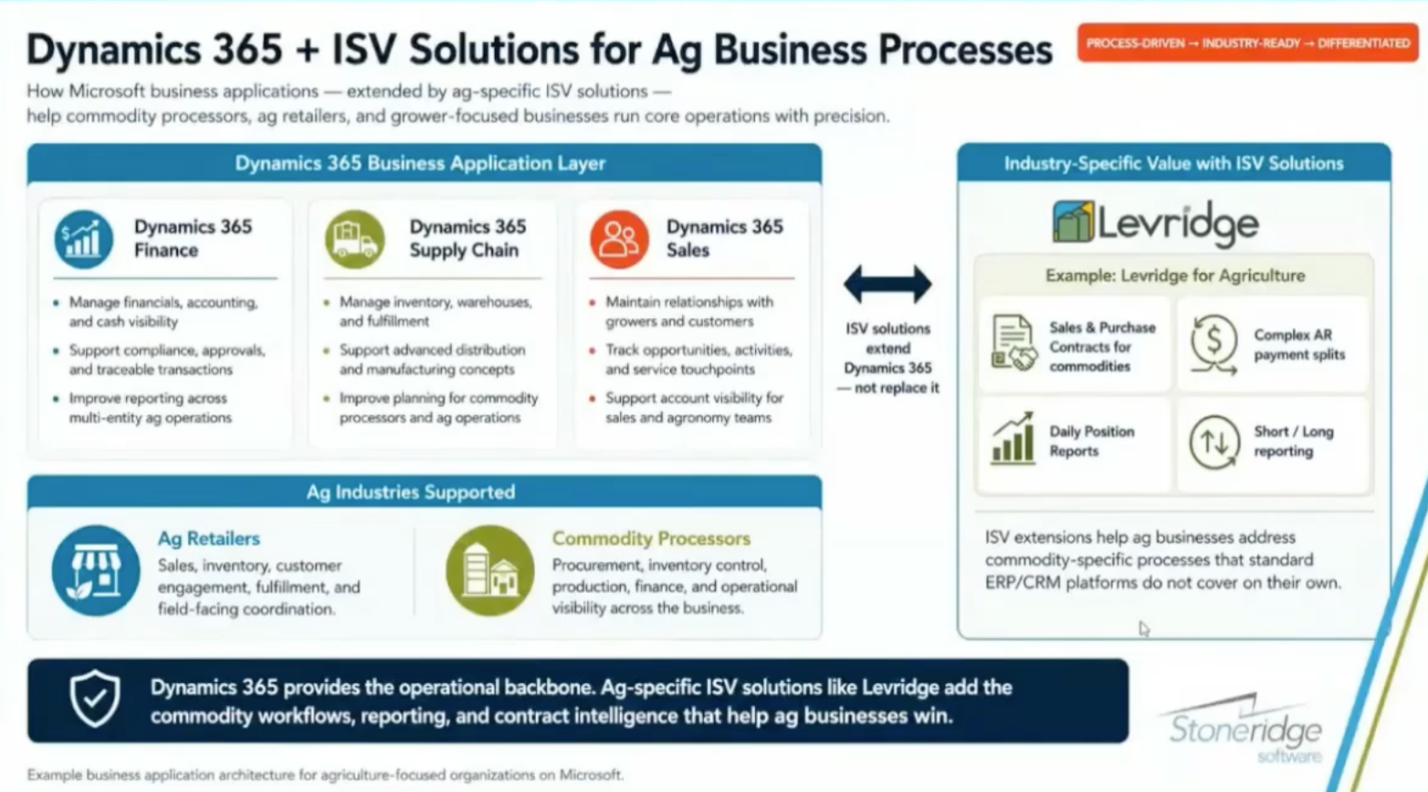
Security is equally important. AI can make information easier to find, so existing permissions and access controls need to be configured correctly before expanding its use. The goal is to give AI access to the information it needs while maintaining appropriate controls around sensitive business data.
The platform can also be extended to address specific processes. An AP solution, for example, can use AI and computer vision to read invoices, enter information into Dynamics, and support three-way matching.
With this foundation in place, AI can move beyond providing information to taking action and carrying out steps within a business process.
Expanding the possibilities from Copilot to AI Agents
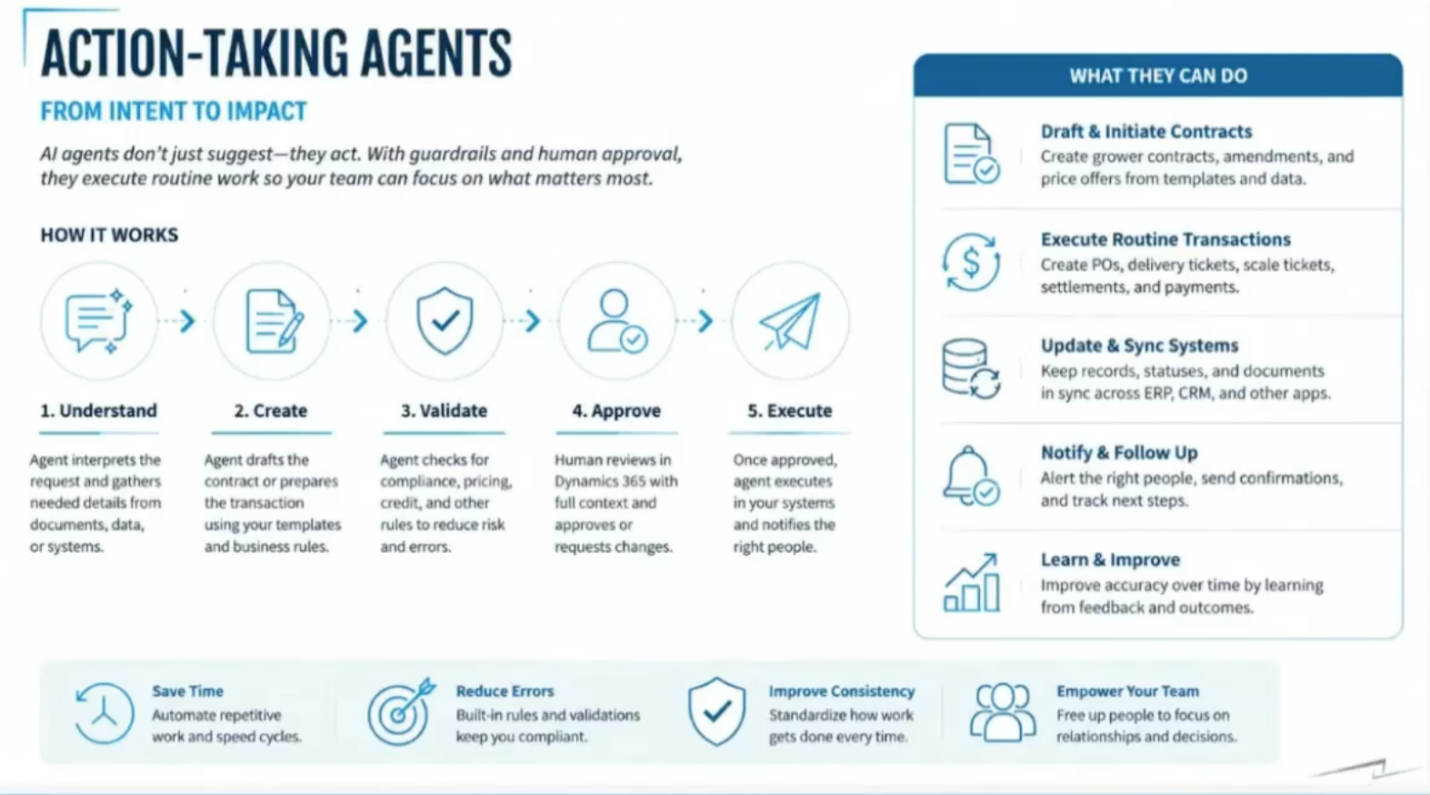
Copilot and AI agents represent two different levels of interaction with AI. Copilot helps you complete a task by providing information, generating content, or answering questions. That can be useful on its own, but AI agents take the next step by working toward a goal and carrying out the steps needed to accomplish it.
For example, you might ask an agent to gather information for two farms and prepare a proposal. Rather than simply returning an answer, the agent can determine what information it needs, access the appropriate business systems, apply the required context or formatting, and produce the requested result.
That ability to break a request into subtasks and work across systems is what makes agentic AI particularly relevant to business processes. An agent can potentially research information, retrieve records, communicate with people, update data, and return an outcome without requiring an employee to navigate each step manually.
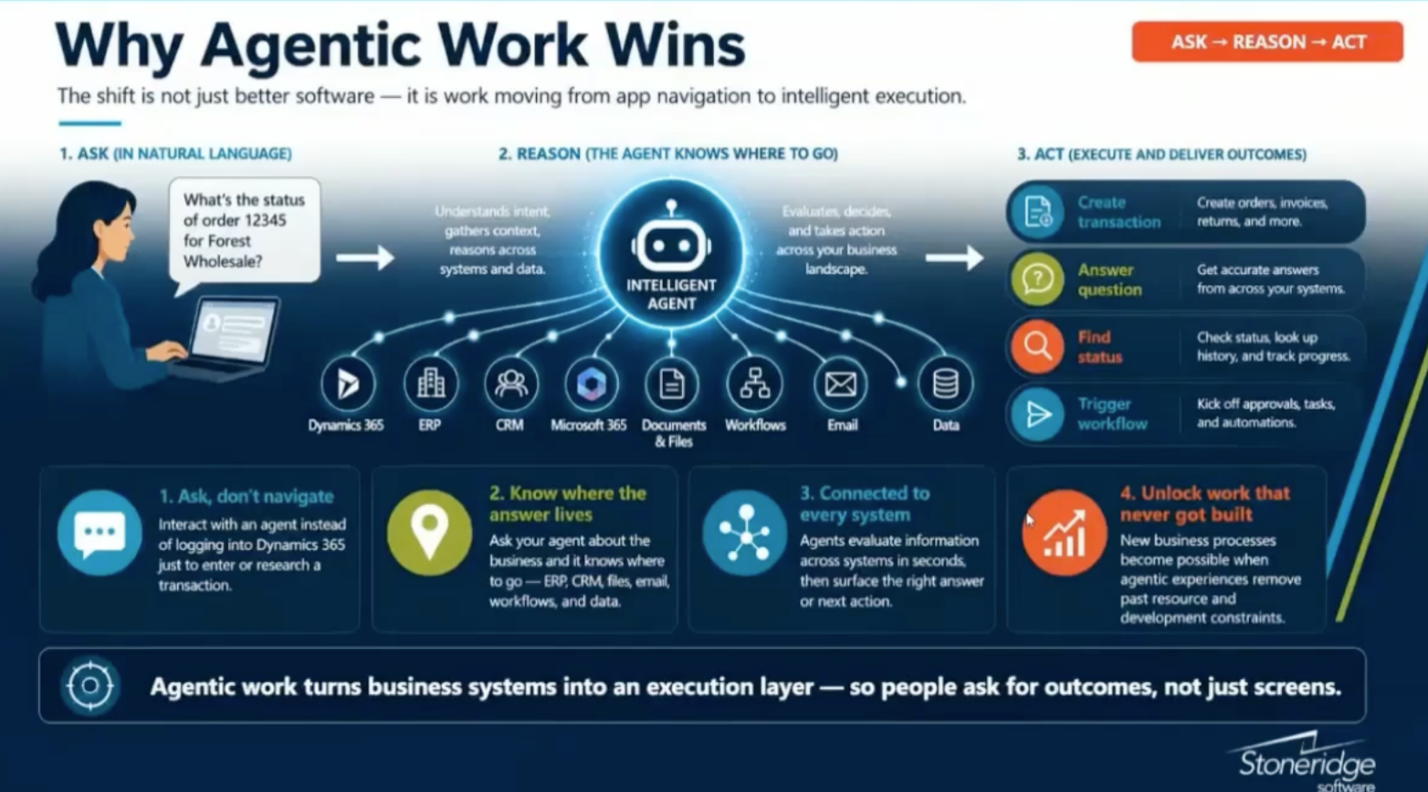
For agribusinesses, this opens up possibilities well beyond drafting emails or summarizing documents. An agent could follow up on a supplier order, research market conditions, reconcile financial transactions, or assemble a daily position report.
The shift is simple: Copilot helps you do something. An agent can work through the steps needed to accomplish something. And that distinction is where AI starts becoming part of the process itself.
With the foundation and capabilities in place, the next question is where AI can deliver practical value in an agribusiness.

Where AI Can Make a Difference in Agribusiness
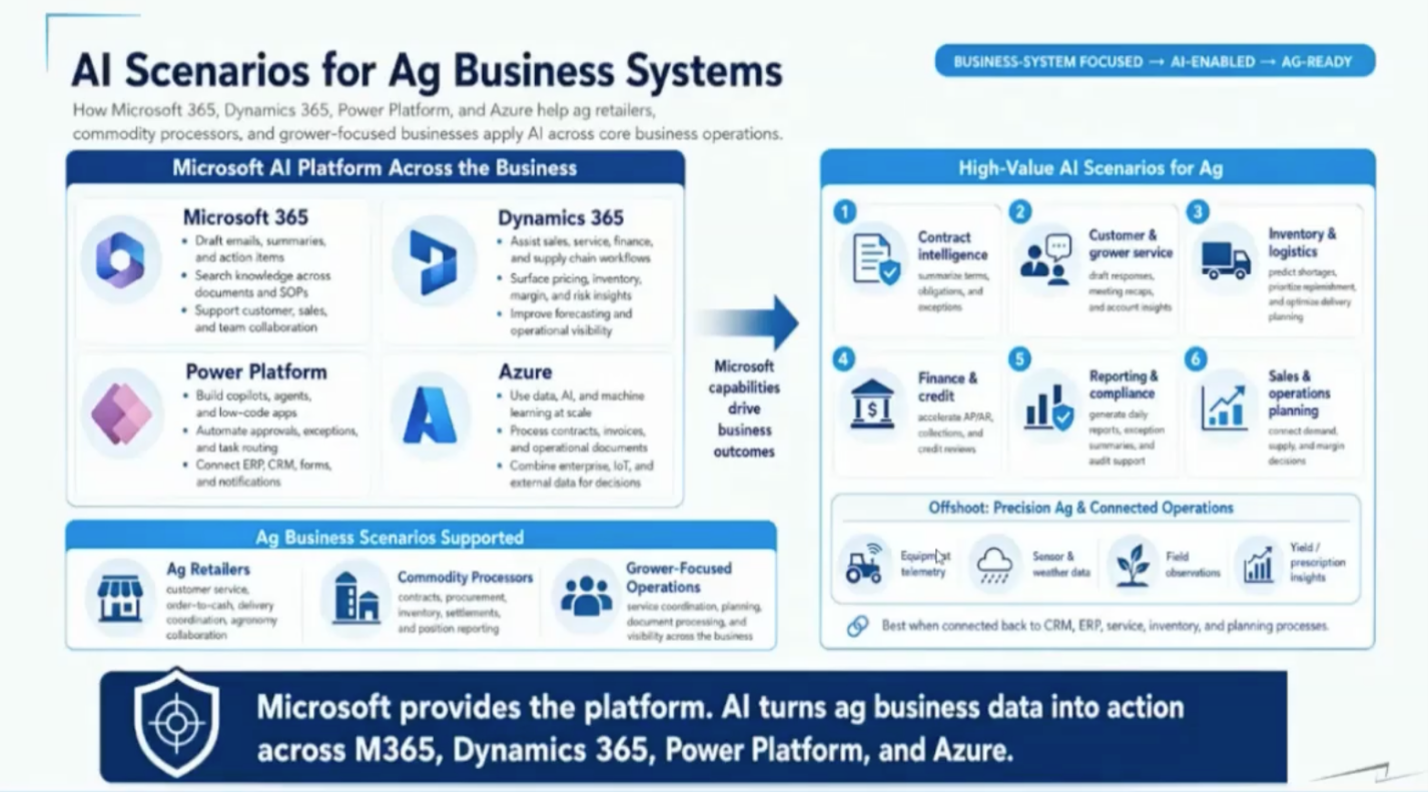
The most useful AI applications are often tied to work that is repetitive, information-heavy, or time-consuming. The following four, practical examples show how AI can move beyond answering questions to support research, supplier communication, financial processes, and recurring business reporting.
Want to see these examples in action? Watch my recorded presentation with my colleague, Joe Tews, where we explore real-world agricultural applications of Microsoft Copilot and AI agents through online demos and examples.
1. Research and Market Intelligence
Agricultural teams regularly need to pull together information from multiple sources to understand markets, evaluate options, or support decisions. A Researcher agent can bring internal business information together with external sources and synthesize the findings into a usable report.
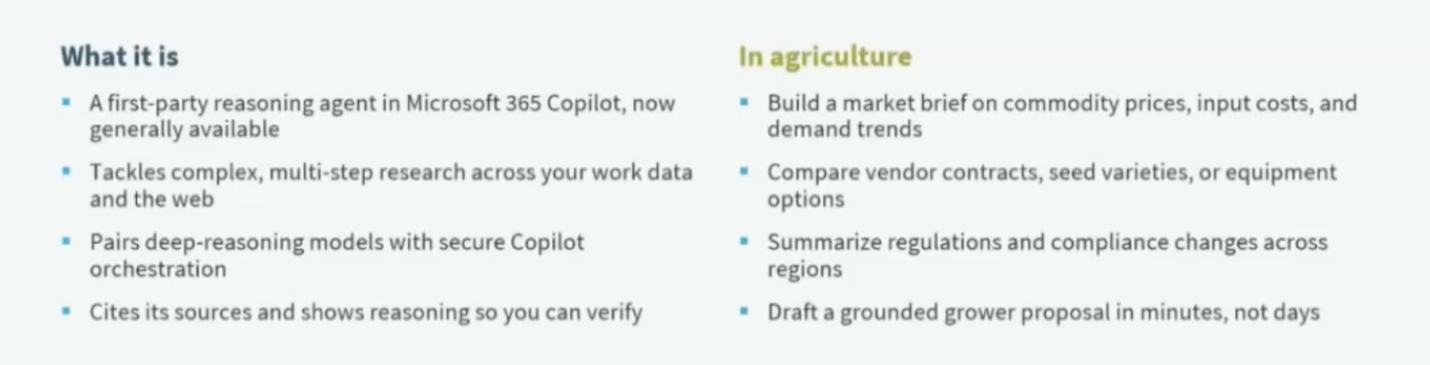
This section of the presentation walks through a soybean price analysis to demonstrate this approach. The agent considers historical prices along with factors such as weather, supply and demand, global trade, and geopolitics, then produces a cited report. The value is not simply getting an answer faster. It gives teams a faster starting point for analysis that would otherwise require significant manual research.
2. Supplier and Procurement Follow-Up
Supplier communication is another practical opportunity, particularly during periods when agribusinesses are managing large volumes of seed, fertilizer, chemicals, or other inputs.
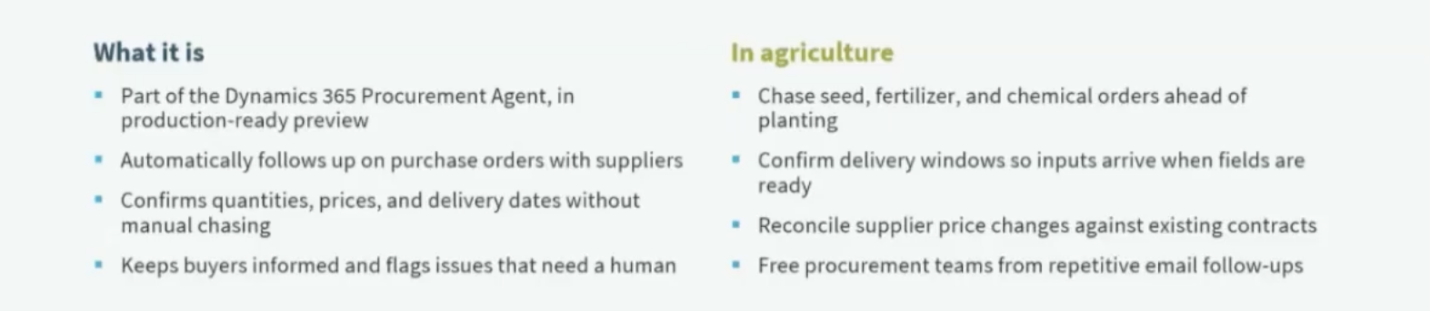
A Supplier Communications Agent can identify purchase orders that need attention, draft follow-up messages, and use supplier responses to help keep delivery information current. In the example shared during the session, the agent handled much of the back-and-forth communication while employees remained responsible for reviewing and approving outbound messages.
This is also a good example of the gradual approach to AI adoption. Start with an agent drafting communications and having an employee review them, then expand its responsibilities as the process proves reliable.
3. Finance and Reconciliation
Reconciliation is another area where AI can shift employees from routine checking to exception-based work. An account reconciliation agent can compare transactions, identify routine matches, and surface discrepancies that require attention.
For agribusinesses, this could apply to areas such as grower payments, input invoices, and bank activity across D365 and Leverage, including identifying potential duplicate payments. Rather than having your team spend their time reviewing every transaction, AI can handle the more routine comparisons and bring exceptions forward for review.
As demonstrated in the session, this can help accounting teams manage seasonal peaks and spend more time resolving issues instead of working through transactions that already match.
4. Daily Position Reports and Business Reporting
Recurring reports can also be a strong fit for AI. A daily position report may require information from contracts, inventory, growers, customers, and commodities to be gathered and organized before it can be distributed.
An agent can together this information, generate the report, and schedule it to be delivered automatically. Instead of someone manually assembling the same information each day, the process can run in the background and provide the report when it is needed.
These examples represent different types of work, but they share a common pattern: AI can reduce the time spent gathering information, following up, checking routine transactions, or assembling reports. As agents become more capable, that opportunity can expand from supporting individual tasks to coordinating multiple steps across a business process.
The next step is identifying where that same potential exists within your own specific business.
What’s Next: AI Agents Across the Agricultural Business
The next stage of AI in agribusiness is not simply doing more tasks. It is connecting those tasks so information can move between people, systems, and processes with less manual intervention.
Consider an agricultural elevator during a busy harvest period. Computer vision could monitor truck queues while information from scale tickets and load times provides visibility into how quickly the facility is moving. An AI system could use that information to identify longer wait times and proactively notify growers about nearby facilities with shorter queues.
Similar capabilities could extend to grower-facing interactions. Similar capabilities could extend to grower-facing interactions. For example, an agent connected to Leverage could allow growers to ask about commodity prices by email, provide the requested information, and initiate the appropriate contract process. From there, additional agents could handle steps such as contract creation and validation, with a person reviewing and approving the final result.
Over time, multiple agents could work together much like different roles within a business. One agent might interact with a grower, another could create and validate a contract, and a person could review and approve it before the process continues.
That is an important distinction between AI and traditional automation. Traditional automation generally follows a predefined path. AI can evaluate the information in front of it and determine which path makes sense based on the situation.
For agribusinesses, that could mean moving from automating individual tasks to building more connected, responsive business processes.
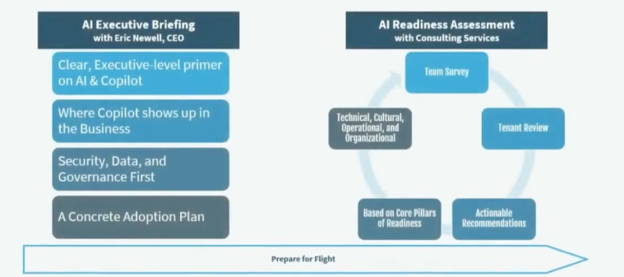
Before expanding AI across the business, you need to understand where you are today and where AI can provide the most practical value. From my experience, the goal is not to adopt AI everywhere at once, but to build a clear path from readiness to real-world use.
How Agribusinesses Can Get Started
Every agribusiness will be at a different stage of AI adoption. Some may be exploring what is possible, while others are already using tools such as Copilot and even agents. Wherever you are starting, a practical approach can help turn interest in AI into meaningful business improvements. I have found these steps in our tried and true Flight Plan program, offered by Stoneridge Software, a reliable place to begin:
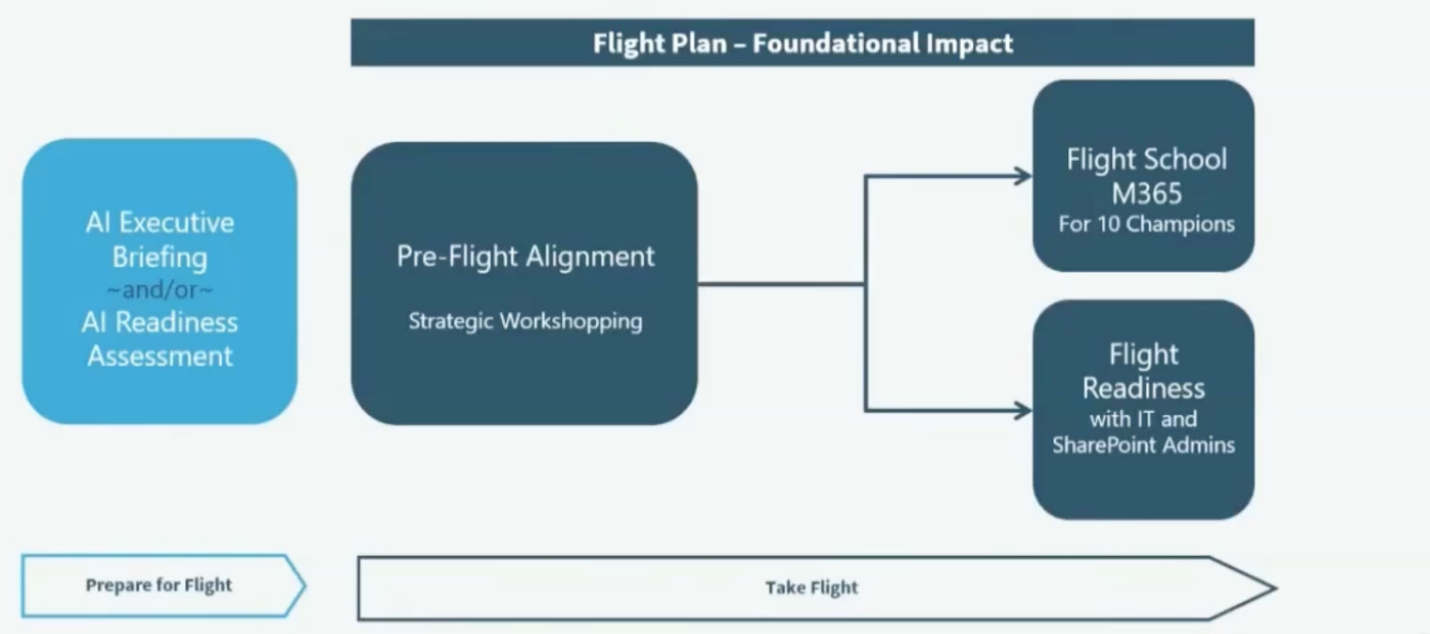
Identify repetitive, information-heavy work that takes you and employees significant time.
- Prioritize the opportunities where AI could reduce effort, improve access to information, or help you respond more quickly.
- Prepare the data, business systems, security, permissions, and processes AI will need to work effectively.
- Pilot a focused use case with appropriate human review. Starting small makes it easier to test the technology, evaluate results, and build confidence.
- Expand what works into additional processes as you gain experience and the organization becomes more comfortable with the technology.
Training is an important part of that process. It is important to understand not only how to use AI tools, but how to prompt them effectively, evaluate their output, and know when human judgment is still required.
I have consistently seen that starting with readiness and a practical use case it gives agribusinesses a way to move forward without trying to solve everything at once.
Give Your Agricultural Teams More Time for the Work That Matters
AI does not need to transform every part of an agribusiness to create value. Some of its most practical applications may be the everyday processes you spend hours managing: following up with suppliers, reconciling transactions, building reports, or pulling together market information.
These are the kinds of tasks AI can increasingly handle in the background, helping you and your employees spend less time gathering information and managing repetitive steps. As AI becomes better at recognizing patterns and determining the next appropriate step, it can support more of the work that happens between systems and processes.
The result is not simply faster work. It is giving agricultural teams more time and attention for the decisions, relationships, and problems that require their experience and expertise.
Need Help Getting Started?
Every agribusiness will have different opportunities for applying AI. The best place to start is by looking at the work your teams are already doing and identifying where AI could reduce repetitive effort, improve access to information, or help move a process forward.
If you're exploring what AI and Microsoft Copilot could look like in your organization, Stoneridge Software can help you identify practical opportunities and determine where to start. Reach out to our team to explore what is possible for your business and how you can take a thoughtful approach to putting AI to work.
This blog is co-authored by Joe Tews

Under the terms of this license, you are authorized to share and redistribute the content across various mediums, subject to adherence to the specified conditions: you must provide proper attribution to Stoneridge as the original creator in a manner that does not imply their endorsement of your use, the material is to be utilized solely for non-commercial purposes, and alterations, modifications, or derivative works based on the original material are strictly prohibited.
Responsibility rests with the licensee to ensure that their use of the material does not violate any other rights.