









D365 Finance and Supply Chain Management Wave 2 – 2026: New Features
Picture this scenario: A Dynamics 365 consultant recently imported 10,000 journal lines in 31 seconds—and that was on the current framework. Now picture that you can generate journal lines in the same timeframe but at a much greater volume.
That rebuilt financial journal is just one piece of this wave. You’ll also see AI that reads remittance advice, agents that follow up with suppliers, a self-service vendor portal, and two end-of-service dates that need a spot on your calendar. Here’s what’s coming to Dynamics 365 Finance and Supply Chain Management, and what it means for you.
A Quick Note on How Microsoft Is Releasing Features
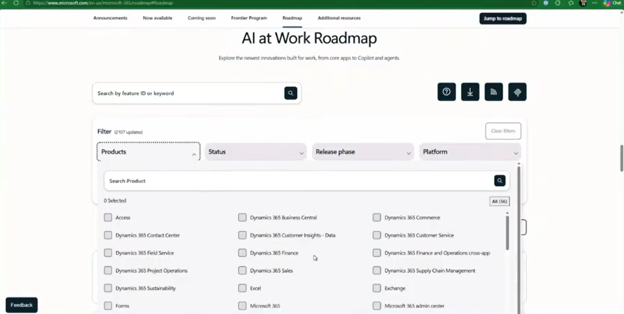
If you’re used to circling “Wave 1” and “Wave 2” on the calendar, here’s the update. Microsoft is retiring defined release waves in favor of continuous updates, tracked on its public “AI at work” roadmap. In practice, features have been arriving gradually for some time, and the roadmap formalizes this continuous-release approach. It also gets new capabilities, especially AI, to you sooner rather than holding them for a release date.
You can still count on Stoneridge Software to bring you the highlights every April and October. We’ll keep running our wave webinars and publishing content, so you get the “what matters for you” version without combing through the roadmap yourself.

How to Explore the Roadmap Yourself
If you want to look under the hood, the roadmap is easy to use. Here’s how:
- Search for Microsoft’s “AI at work” roadmap and open it.
- Use the filters to narrow it to Finance and Operations cross-app and Supply Chain Management.
- Check each feature’s status: in development, preview available, or rolling out.
- Export the list to a CSV file if you want to analyze it. One of our team members dropped the export into an AI assistant and asked which features to highlight.
Finance: A Stronger Foundation
Rebuilt Financial Journals
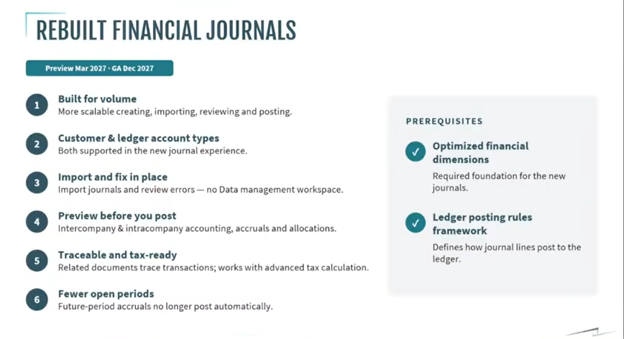
The new framework is built for volume and AI enablement, covering how you create, import, review, and post journals. Public preview arrives with version 10.0.50 next month, and general availability is expected next December. Here’s what you can look forward to:
- Importing journals and reviewing errors without opening the data management workspace
- Previewing intercompany, intracompany, accrual, and allocation entries before posting
- Related documents that make transactions easier to trace
- Advanced tax calculation
- Future-period accruals that no longer post automatically, so you don’t need to keep future periods open
- Different customer and ledger account types
There are two prerequisites, both worth having anyway: optimized financial dimensions and the ledger posting rules framework.
AI-Powered Remittance Advice
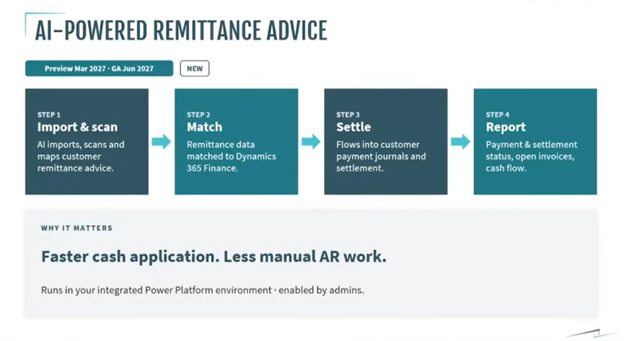
Imagine your team no longer having to key in remittance details by hand. This capability imports, scans, and maps customer remittance advice in the Power Platform. It then matches the data to Dynamics 365 and flows it into a customer payment journal and settlement. Reporting covers payment and settlement status, outstanding invoices, and cash flow. Preview starts in March 2027, with general availability targeted for June 2027.
Features You Can Test Now
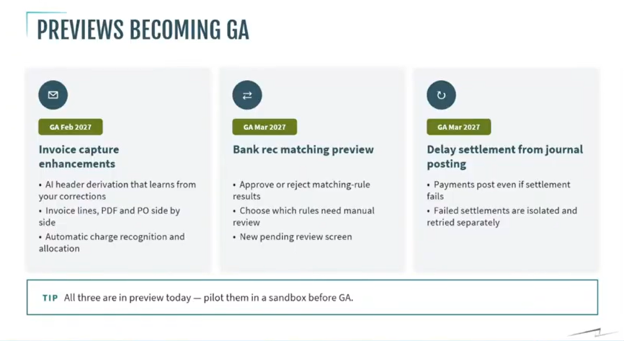
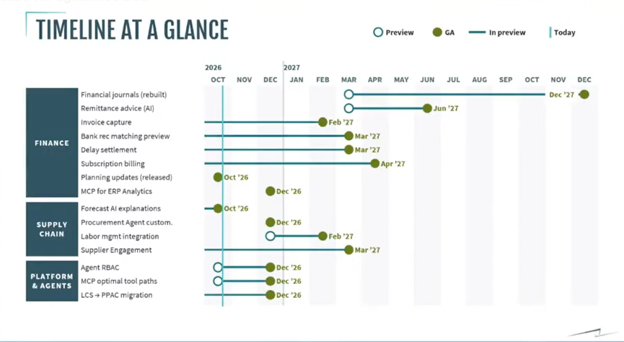
- Invoice capture: The AI learns from your corrections, and the PDF and purchase order display side by side. It also automatically recognizes and allocates charges. You can define where fields sit on older invoice layouts without building a new AI Builder model for each one. Charge recognition is expected in February 2027.
- Delayed settlement from journal posting (March 2027): Payments can post even if settlement fails, and failed settlements are isolated and retried separately.
- Bank reconciliation matching: You can approve or reject matching-rule results, choose which rules need manual review, and work from a pending review screen.
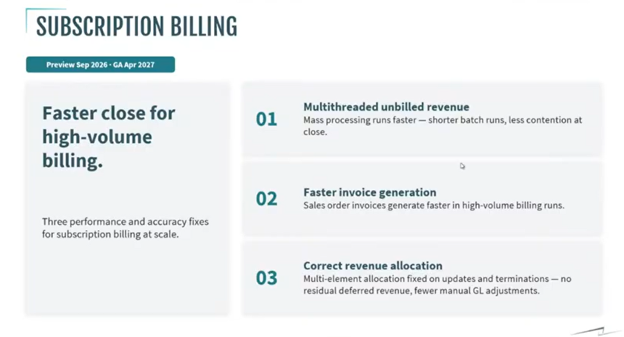
- Subscription billing performance (general availability in April): You get multi-threaded unbilled revenue processing, which means faster batch runs and less contention at period close. You also get faster invoice generation for high-volume billing runs and corrected multi-element revenue allocation on updates and terminations, which means fewer residual deferred revenue balances and manual GL adjustments. If you generate thousands of invoices, speed is revenue.
Business Performance Planning and Analytics
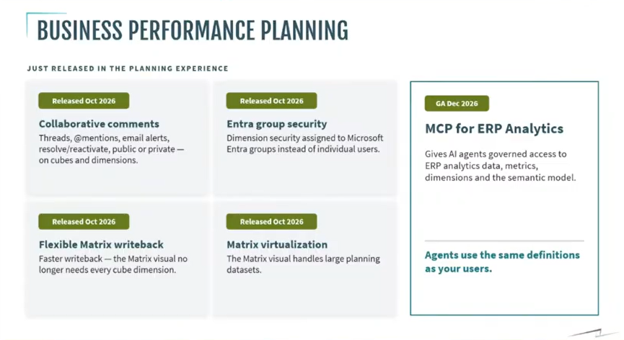
Collaborative comments, group security, matrix writeback, and virtualization were all released in October. In December 2026, MCP for ERP analytics gives AI agents governed access to your metrics, dimensions, and semantic model. In plain terms, you’ll be able to ask questions of your ERP business performance analytics data.
Supply Chain: More Automation, Better Supplier Relationships
Procurement Agent Upgrades
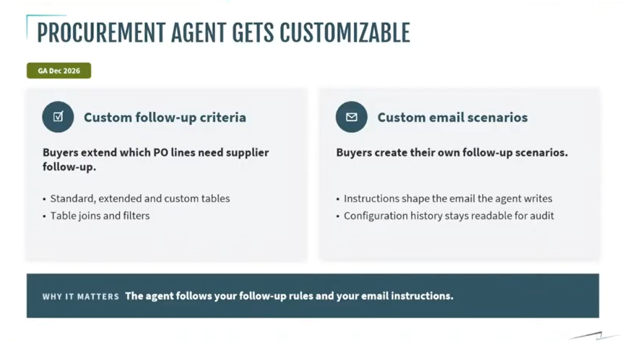
Starting in December 2026, buyers are expected to be able to decide which PO lines need supplier follow-up, using standard, extended, or custom tables with joins and filters. Buyers can also create their own follow-up scenarios, with instructions that shape the emails the agent writes. Configuration history stays readable for audits.
Supplier Engagement
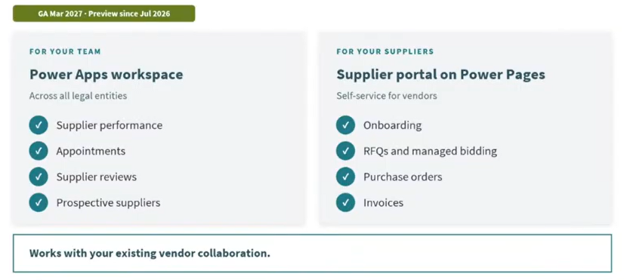
Preview is available now and includes two parts:
- A Power Apps workspace across all legal entities for tracking supplier performance, appointments, reviews, and prospective suppliers.
- A supplier portal on Power Pages with self-service for your vendors. Suppliers can handle onboarding and RFQs and view purchase orders and invoices.
Labor Management Integration
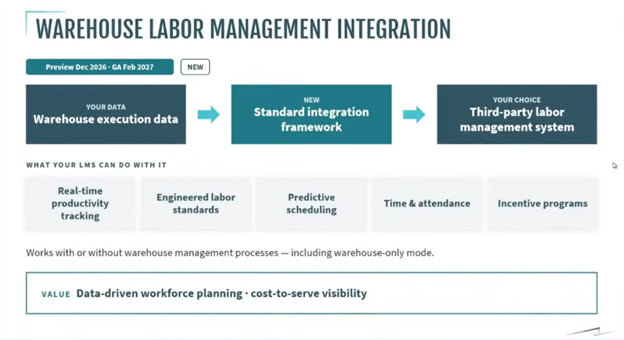
If you use a separate labor management system, you’ll get a standard framework to connect it to Dynamics 365. It supports real-time productivity tracking, engineered labor standards, predictive scheduling, time and attendance, and incentive programs. It works with or without full warehouse management, including warehouse-only mode. Preview starts in December, with general availability in February 2027.
Demand Forecasting with AI Explanations
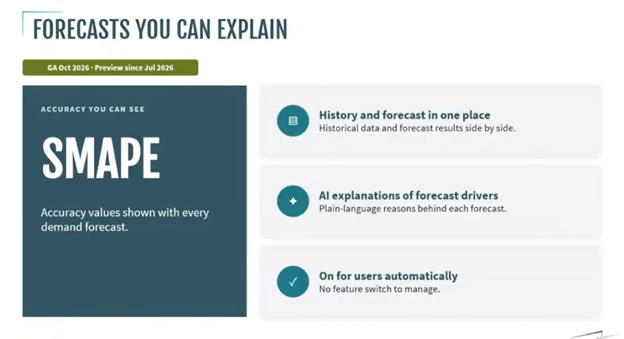
This one reached general availability in October. Forecasts now show SMAPE (symmetric mean absolute percentage error) accuracy values, so planners can judge quality briefly. You also get historical data and forecast results in one place, plus AI-generated explanations of what’s driving the forecast. It’s enabled for users automatically, so it’s worth a quick walkthrough with your planners.
Rental Management
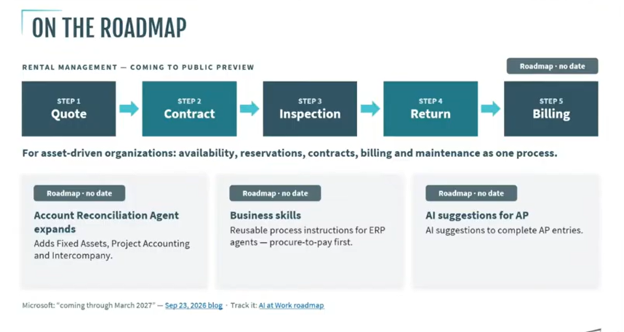
A full rental management solution is in private preview, with public preview expected soon. It covers the lifecycle from quote to contract, inspection, return, and billing. If your business is asset-driven, keep an eye on it.
Agents, Security, and Administration
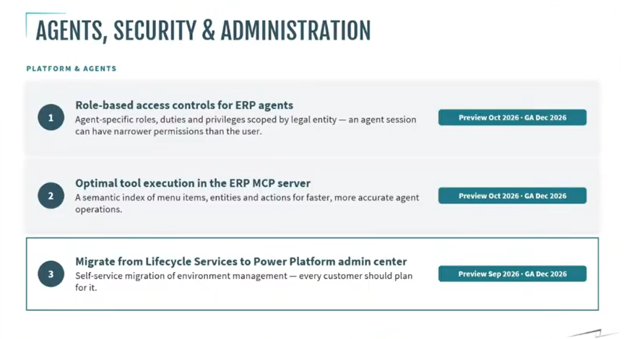
Three platform items matter whether you’re on finance, supply chain, or both. All are in preview, with general availability expected in December 2026:
- Role-based access control for ERP agents: Today an agent inherits the permissions of whoever created it. Agents will get their own roles, duties, and privileges, scoped by legal entity, so an agent session can have narrower permissions than the user running it.
- Optimized MCP tool execution: A semantic index of menu items, entities, and actions should make agent operations faster and more accurate.
- LCS migration agent: A self-service agent helps move environment management from Lifecycle Services to the Power Platform admin center. If you’ve been putting that move off, this may help.
The Account Reconciliation Agent Keeps Growing
Inventory reconciliation is already available in the agent, and fixed assets, project accounting, and intercompany are coming (no dates yet). Here’s how it plays out:
- Someone makes a direct posting to an account that represents inventory, bypassing the subledger.
- Your inventory on hand and your GL no longer reconcile.
- The agent flags the exception and tells you exactly why it happened.
- You correct the inventory transaction right from the exception.
AI suggestions to complete AP entries are also on the roadmap, though no date has been given.
Two Dates to Put on Your Calendar
- Version 10.0.47 reaches end of service in November. Make your update plan now.
- Export to Azure Data Lake ends on November 30, 2026. It was deprecated in November 2024. If you still rely on it, move to Synapse Link before then.
Make the Most of What’s Next with Stoneridge Software
Between the rebuilt journals, new AI agents, and a couple of firm deadlines, this wave rewards businesses with a plan. That’s where Stoneridge Software comes in. We can help you check your environment for the end-of-service items, turn on and test preview features in a sandbox, decide which AI capabilities fit your processes, and connect the pieces across Dynamics 365 and the Power Platform.
If you want to implement, integrate, and get the most out of new features and AI in your Microsoft solutions, contact Stoneridge Software today.

Under the terms of this license, you are authorized to share and redistribute the content across various mediums, subject to adherence to the specified conditions: you must provide proper attribution to Stoneridge as the original creator in a manner that does not imply their endorsement of your use, the material is to be utilized solely for non-commercial purposes, and alterations, modifications, or derivative works based on the original material are strictly prohibited.
Responsibility rests with the licensee to ensure that their use of the material does not violate any other rights.